How to Charge a Car Battery with a Charger: An ASE Master Tech's Guide (2026)
An ASE Master Tech on charging a car battery properly: real charge times and rates, the voltage-to-state-of-charge table, AGM and lithium modes, and why the negative clamp goes on chassis ground.
Updated
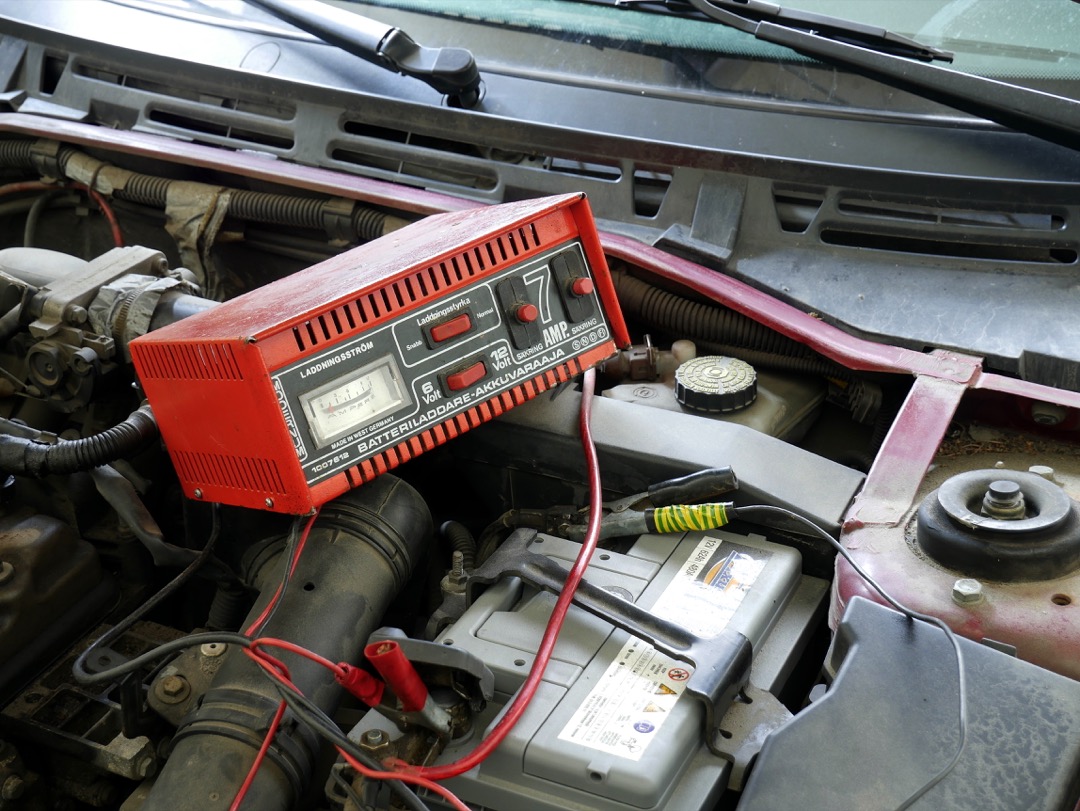
A car that clicks instead of cranking is usually carrying a discharged battery rather than a failed one. A charger puts the charge back properly, over hours, at a rate the plates can absorb. Jump starting is a different job: it borrows enough current to fire the engine once, then leaves the recharging to an alternator never built for it. For that, see our guide to jump starting a car.
Four things account for most of what goes wrong: cutting the charge short, clamping the negative lead in the wrong place, the wrong chemistry mode, and charging a frozen battery.
Charging a Car Battery at a Glance
Time required: Four to eight hours for a partial recharge at 10 amps. Twenty-four hours or more from fully flat at 2 amps.
Difficulty: Easy. Two clamps, one switch, and the patience to leave it alone.
Tools: A charger sized for your battery, a multimeter, safety glasses, a wire brush, baking soda and water.
What it fixes: Lights left on, a door left ajar, a short-trip pattern the alternator never catches up with, or a car parked for a month. It also rescues a battery living at partial charge, which is what kills batteries slowly.
What it does not fix: A shorted cell, capacity lost to age, a failing alternator, a parasitic draw, or corroded cables. A charger replaces charge, not plate material.
Safety: What Actually Makes This Job Dangerous
Never charge a battery you suspect has frozen. Let it thaw completely at room temperature first. Charging a frozen battery can rupture the case, because the electrolyte is solid and the gas you generate has nowhere to go. Freezing point tracks state of charge: a full battery’s electrolyte holds out to roughly minus 80 degrees F, at 40 percent charge it freezes around minus 16 degrees F, and a fully discharged battery freezes around plus 20 degrees F. The flat battery is the one that freezes, which is exactly the one somebody is about to connect a charger to. Look for a bulged or cracked case, or a battery that takes no current. Our winterizing guide covers avoiding that state.
Hydrogen is the other hazard. Lead-acid batteries vent it while charging, most heavily at the end. It is lighter than air, so it pools at the top of an enclosed space, and it burns across a wide range of concentrations. Hood up or garage door open, never a sealed closet.
A rotten-egg smell means overcharging or an internal fault. Unplug at the wall first, then pull the clamps, so you are not sparking next to vented gas. Glasses on, rings and watch off.
Before You Connect: Inspect the Battery
Check the case for bulging, splits, or an opened seam. A swollen case means heat damage or a frozen battery, and either way the charger stays in the box.
Clean the terminals. Fluffy white or blue-green corrosion has real resistance, and a charger that sees it at the clamp charges slowly or throws a fault that is not the battery’s. Wire brush for light corrosion, baking soda and water for the rest.
If the battery has caps, top up any cell with exposed plates before charging, distilled water only. AGM cannot be topped up at all. Then take a resting voltage reading.
Should You Take the Battery Out of the Car?
Usually not. Charging in place with the battery connected is normal and is what charger makers assume.
Pulling it costs you radio codes, seat and mirror memory, and on some cars an idle or window relearn. An OBD-port memory saver holds those settings, but it leaves the circuits live, so it is no excuse for carelessness near a positive terminal.
Real reasons to pull it: no safe ground point, a battery under a rear seat or in the trunk with poor ventilation, or one whose tray needs cleaning.
Connecting the Charger: Why the Negative Clamp Does Not Go on the Battery
Order: charger unplugged from the wall, red clamp to the positive post, black clamp to a clean unpainted chassis or engine ground point, then plug in and switch on. Reverse that to disconnect. Two separate reasons put the black clamp there, and both are real.
The first is the old one. The last connection you make is the one that sparks, and you want it several inches from a battery venting hydrogen. A clean bolt head, a lift bracket, or a factory ground strap works. Paint and plastic do not.
The second catches out people who have done this the old way for thirty years. Many vehicles carry a battery current sensor clamped to the negative cable at the post. GM calls it the battery current sensor, BMW and others an IBS, or intelligent battery sensor. Every amp entering or leaving the battery is supposed to pass through it so the body control module can track state of charge. Clamp a charger’s negative lead straight to the post and the charge current goes around that sensor. The battery fills and the car never sees it. GM service information sends the negative charger lead to chassis ground for exactly this reason.
Do not unbolt or unplug the sensor to get at the post. That comes off when you replace the battery or the sensor, not otherwise.
Picking the Right Setting for Your Battery Chemistry
The most expensive setting to get wrong on a modern car.
Flooded lead-acid is the default on every charger, capped or sealed.
AGM needs its own mode. Absorption typically runs 14.4 to 14.8 volts, and AGM must never be equalized. The mode matters because AGM cannot be topped up with water: an old unregulated charger set for flooded batteries can overcharge it and drive electrolyte out as gas, and that electrolyte is gone permanently along with the capacity it held. AGM is standard on most stop-start vehicles. EFB wants an EFB mode if the charger has one.
Lithium, meaning LiFePO4 starting and accessory batteries, needs a lithium profile. Never run a lead-acid desulfation or equalize mode at one. The pulses and the higher voltage can trip or damage the internal battery management system, and a BMS that has latched off makes a healthy battery look dead.
Rate matters too. Manufacturers commonly recommend up to 0.3C, and the practical automotive rule is 10 to 15 percent of the amp-hour rating, roughly 4 to 10 amps for most car batteries. Never exceed 20 amps on a manual charger with no automatic cutoff. Excess current raises internal temperature, which warps plates, boils electrolyte, and drives hard gassing. The engine-start or boost setting is short-duty only and is not a charging mode. Our car battery chargers roundup covers which units support which chemistry.
How Long Does It Actually Take?
How long to charge a car battery comes down to how flat it is, how big it is, and how many amps the charger delivers. The working formula is hours equals the amp-hours you need to replace divided by charger amps, times 1.2. That 1.2 covers charging inefficiency: lead-acid is only about 85 percent efficient.
A 50 amp-hour battery at 50 percent needs about 25 amp-hours back, so at 10 amps that is about 3 hours of bulk charging. From fully flat, the same battery is roughly 25 to 30 hours at 2 amps, 5 to 6 hours at 10 amps, and 2.5 to 3 hours at 20 amps.
That covers the bulk, not the end. A charge runs in three stages, laid out in Battery University’s BU-403. Bulk, at constant current, reaches 70 to 80 percent, typically 5 to 8 hours on a conventional charger. Absorption switches to constant voltage at 2.30 to 2.45 volts per cell, about 13.8 to 14.7 volts on a 12-volt battery, and delivers the last 20 to 30 percent over another 7 to 10 hours. Float holds 2.25 to 2.27 volts per cell, around 13.5 to 13.6 volts.
Absorption is the stage people cut short. It is slow by design: as the plates fill they accept less current, and pushing harder makes heat and gas, not charge. The battery is full when accepted current tapers to 3 to 5 percent of the amp-hour rating. Temperature moves the target too: about minus 3 millivolts per degree C per cell, roughly minus 18 millivolts per degree C for a 12-volt battery, referenced to 25 degrees C. Cold wants higher, heat wants lower, and good chargers compensate with a temperature sensor.
Reading State of Charge from Voltage
A multimeter across the posts tells you most of what you need. These are the standard industry reference figures for a 12-volt flooded lead-acid battery at rest, around 77 degrees F.
| Resting voltage | State of charge |
|---|---|
| 12.6 to 12.7 V | 100 percent |
| about 12.45 V | 75 percent |
| about 12.24 V | 50 percent |
| about 12.06 V | 25 percent |
| 11.9 V or below | fully discharged |
Two caveats decide whether the reading means anything. First, surface charge: a battery just charged or just driven reads falsely high. Rest it several hours, or switch the headlights on for about 30 seconds and wait a couple of minutes before measuring. Skip that and a tired battery reads healthy.
Second, temperature: the chart assumes a 77 degree F baseline, and cold depresses the reading, so a cold battery reads lower than its true state of charge.
Day to day, 12.4 volts is the line that matters. Below it a battery is living partially discharged, which is what grows sulfation. Our battery maintenance guide covers keeping it above that.
Disconnecting, and Checking That the Charge Held
Switch the charger off and unplug it at the wall before you touch a clamp. Negative clamp off the ground point first, positive off the post second. Then let it rest. An hour works, several hours is better, and the reading you want is 12.6 volts or better.
Then the part almost everybody skips. A battery that reads a full 12.6 volts and still cranks slowly has lost capacity, not charge. Voltage says nothing about the current a battery can deliver under load. Only a load or conductance test shows that, which is why a tester belongs in the same drawer as the charger. Our battery testers roundup covers what those tools measure.
Modern Cars: Battery Sensors and Why the Dash Still Complains
Clamp to the post instead of chassis ground and the sensor never sees the charge, so the module’s state-of-charge estimate stays the flat one it had before you started. On a stop-start vehicle that shows up as stop-start refusing to engage, or a charging message that will not clear, on a car that is now healthy.
The fix is usually to drive it. The sensor reads real current in and out, and after a drive cycle or two the module catches up. To read or clear a charging code while you chase it, a capable OBD2 scanner gets you there.
When Charging Will Not Fix It
Three failures look like a discharged battery.
A shorted cell. Each healthy cell contributes about 2.1 volts, so six make about 12.6. One cell shorted internally and the battery tops out around 10.5 volts, however long the charger runs. It often warms and gasses while the charger still reports charging. That battery is finished. Many smart chargers also refuse to start below a minimum detect voltage, often a few volts, and need a supply or force mode.
A parasitic draw. If a battery takes a full charge, holds it on the bench, and is flat again two days after going back in the car, the fault is a draw. Key-off current typically settles around 20 to 50 milliamps once every module sleeps, which can take 20 to 45 minutes after the doors are shut. Measure it with a multimeter in series with the negative cable, wait out that sleep period, then pull fuses one at a time. A meter is on the list in our essential DIY tools guide.
Lost capacity and hard sulfation. A battery that charges fully and fails a load test has lost plate capacity, and nothing puts that back. Which brings up desulfation mode, sold as recondition or repair. Battery University’s BU-804b is blunt about it. Soft, early sulfation can sometimes be reduced by a controlled low-current overcharge on an already fully charged battery, around 200 milliamps. Hard sulfation, which sets in after weeks or months at a low state of charge, is not recoverable by any method. Pulse devices lower sulfation on a healthy battery but cannot reverse it once present, and blind pulsing or induced overcharge promotes grid corrosion, heats the battery, and can create soft internal shorts that raise self-discharge. My take: worth one attempt on a battery you were replacing anyway. It is not a repair.
Charger, Jump Pack, or Jumper Cables?
A charger replaces charge over hours. It is the only one of the three that leaves a battery genuinely full. A maintainer is the same tool with a long duty cycle, for a vehicle that sits.
A jump pack gets an engine running now, but it charges nothing, so the battery still needs a long highway run or a charger afterwards. Our jump starters roundup covers capacity and safety, and NOCO vs Schumacher compares the two brands most people choose between. Jumper cables do the same job but need a second running vehicle.
Own both. One does not cover the other.
Final Word from the Shop
Red clamp to the positive post, black clamp to chassis ground, the mode that matches what is in the case, a rate around 10 percent of the amp-hour rating, and the patience to let absorption finish. The difference between a battery that lasts five years and one that lasts two sits almost entirely in that last part.
Two things I tell every customer. Check resting voltage before and after, surface charge rested off. And if a fully charged battery still cranks slowly, stop charging and load test it, because that is a capacity problem no charger solves. Picking the charger is covered in our car battery chargers roundup.
Buyer's Guide
A charger is one of the few tools where the cheap version and the good version do genuinely different jobs. Six things decide whether the one you buy keeps a battery healthy for years or just puts current into it until something stops.
Charger Amperage Against Your Battery's Amp-Hour Rating
Match the charger to the battery rather than buying the biggest number on the shelf. Manufacturers commonly recommend charging at up to 0.3C, and the practical automotive rule is 10 to 15 percent of the battery's amp-hour rating, which lands around 4 to 10 amps for most car batteries. A 10 amp charger covers nearly every passenger car and light truck battery comfortably. Going higher buys less than people expect, because the slow part of a charge is the absorption stage at the end, and no amount of current shortens that. Going much higher on a manual charger with no automatic cutoff is actively harmful: excess current raises internal temperature, which can warp plates, boil electrolyte, and drive hard gassing. Never exceed 20 amps on an unregulated unit. At the other end, a 2 amp trickle charger is fine for maintaining a battery or for a small powersports battery, but from fully flat it will take a car battery well over a day. If you have both a car and something that sits, a charger with selectable rates covers both without owning two units.
Chemistry Support: Flooded, AGM, EFB, and Lithium
Chemistry support is the first thing I look at, because the wrong mode causes damage that no later charge undoes. Conventional flooded batteries are the default setting on every charger. AGM needs its own mode, with absorption typically at 14.4 to 14.8 volts, and it must never be equalized. The stakes are higher with AGM than with flooded because AGM cannot be topped up with water, so electrolyte driven out by an overcharge is gone permanently along with the capacity it supported. AGM is standard on most stop-start vehicles, so a charger without an AGM mode is already outdated for a large share of cars on the road. EFB, the other common stop-start chemistry, wants an EFB mode if the charger has one. Lithium, meaning LiFePO4 starting and accessory batteries, needs a dedicated lithium profile. A lead-acid desulfation or equalize cycle aimed at a lithium battery can trip or damage the internal battery management system, and a latched BMS makes a healthy battery read as dead. Check the label on your battery before you buy the charger, not after.
Smart Multi-Stage Charging Versus a Manual Unregulated Unit
A proper charge runs in three stages. Bulk, at constant current, brings the battery to roughly 70 to 80 percent. Absorption, at constant voltage between about 13.8 and 14.7 volts on a 12-volt battery, delivers the last 20 to 30 percent and takes far longer than people expect, commonly 7 to 10 hours on a conventional charger. Float then holds around 13.5 to 13.6 volts and simply maintains. A smart multi-stage charger walks through those stages on its own, tapers current as the battery fills, and stops or drops to float when accepted current falls to about 3 to 5 percent of the amp-hour rating. A manual unregulated charger does none of that. It pushes current until you unplug it, which means it either gets switched off early, leaving the battery short of full and slowly sulfating, or gets left on, overcharging and gassing the battery. The old units still work and shops still keep one around for stubborn cases, but for anybody charging a battery a few times a year, multi-stage is the whole point.
Temperature Compensation and Where the Battery Actually Lives
Correct charging voltage moves with temperature, by about minus 3 millivolts per degree C per cell, which is roughly minus 18 millivolts per degree C for a 12-volt battery, referenced to 25 degrees C. Cold wants a higher voltage to reach a full charge, heat wants a lower one to avoid overcharging. A charger that holds a single fixed voltage regardless of conditions will therefore undercharge a battery in an unheated garage in winter and overcharge the same battery in a hot one in August. Undercharging leaves the plates partially sulfated and slowly kills the battery. Overcharging boils off electrolyte, which is a permanent loss on an AGM. Chargers that compensate do it with a temperature sensor, either built into the case or on a lead you attach to the battery, and the lead version is the more accurate of the two because it reads the battery rather than the room. This matters most if you charge outdoors, in an unheated garage, or in a climate with wide seasonal swings. In a conditioned space it matters less.
Maintainer Duty: Can It Be Left Connected for Months
Charging and maintaining are different duty cycles, and not every charger is rated for both. A maintainer is designed to stay connected indefinitely, holding float voltage and topping the battery only as self-discharge draws it down. That is what a classic car, a boat, a motorcycle, an RV, or a second vehicle that sits through the winter actually needs, and it is the single best thing you can do for battery life, because a battery stored at a partial state of charge sulfates. Look for an explicit statement that the unit can be left connected long term, and check whether float is genuinely a maintenance stage or just the charger idling at full voltage, which will cook a battery over months. Many units do both jobs and switch automatically once the charge completes. If you have a vehicle that sits more than a few weeks at a time, buy a charger that says plainly it is rated to stay on, and put it on a timer or a smart plug if you want belt and braces.
Safety and Usability Features That Actually Matter
A short list earns its keep and the rest is packaging. Reverse-polarity protection is first, because red on negative is the mistake that takes out modules and the charger together, and it is easy to make in a dark driveway. Spark-free connection means the charger does not energize its output until it confirms a correct connection, which matters because you are working near a battery that vents hydrogen. A real state-of-charge readout is the feature I would pay for above any other: a display showing actual voltage, delivered amps, and the current stage tells you what is happening, while a single light that changes color tells you nothing about whether the absorption stage finished. Thermal protection and automatic shutoff stop a fault from turning into a hot charger left running overnight. Clamps matter more than the spec sheet suggests, since thin jaws and flimsy springs make poor contact on a corroded post and give you a slow charge you will blame on the battery. Cable length decides whether you can reach a ground point without stretching the leads across a belt.
Frequently Asked Questions
Is a 20-minute drive enough to charge a car battery?
Can charging a battery damage a modern car's electronics?
What charger setting should I use for an AGM or lithium battery?
How do I know if my battery just needs a charge or needs to be replaced?
Does cold weather change how long a battery takes to charge?
Related Articles
How to Jump Start a Car Safely: A Step-by-Step Guide From an ASE Master Tech (2026)
roadside-safety
7 Best Car Battery Chargers of 2026
car-electronics
9 Best Car Battery Testers of 2026
car-electronics
Car Battery Maintenance Guide: How to Extend Your Battery's Life (2026)
maintenance-parts
How to Winterize Your Car: A 20-Point ASE Technician's Checklist (2026)
roadside-safety
About the Reviewer

Mike Reeves, ASE Master Technician
A.A.S. Automotive Technology, Universal Technical Institute (UTI)
Mike Reeves is an ASE Master Technician with 15 years of hands-on experience in automotive repair and diagnostics. He earned his A.A.S. in Automotive Technology from UTI and runs his own independent shop in Denver, Colorado. Mike founded RevRated to help everyday car owners make smarter parts decisions -- every recommendation comes from real-world testing in his garage.