9 Best Car Battery Testers of 2026
Mike Reeves, ASE Master Tech, reviews the best car battery testers of 2026. Compare conductance testers, load testers, alternator testers, and charger-tester combos for AGM, EFB, and lithium batteries.
Updated
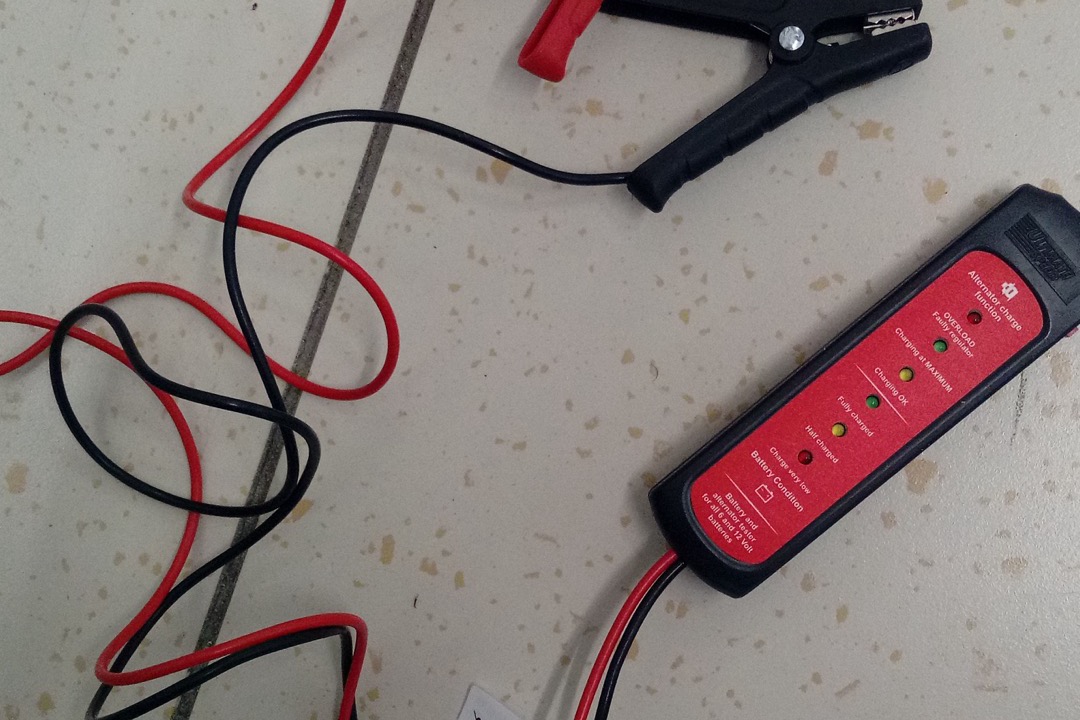
I am an ASE Master Technician with 15-plus years running an independent shop in Denver, and the question I get asked more than any other in the late fall and early spring is some version of “is my battery dying?” Half the time the answer is no — the battery is fine, the alternator is undercharging, or the customer left a dome light on for two days. The other half it is yes, and the customer just spent forty dollars on a test at a chain store that they could have run themselves in fifteen seconds with a sixty-dollar tester sitting in their toolbox. A car battery tester is one of the highest-leverage tools a driver can own, and the 2026 lineup is genuinely good across every price tier, from a glovebox voltmeter to a hundred-dollar-plus shop analyzer.
For this roundup, I tested nine battery testers across CCA accuracy, chemistry support (flooded, AGM, EFB, lithium), 12V and 24V system handling, and the cranking and alternator load test functions that separate a real diagnostic tool from a glorified voltmeter. The cheapest unit on this list is a voltmeter that I would still keep in the glovebox; the most expensive is a dual-voltage shop unit that pays for itself in a single avoided alternator misdiagnosis. Pair this guide with our car battery charger review — the tester tells you what is wrong, the charger fixes what can be fixed, and together they cover most of the no-start calls a typical driver will ever face.
After working with each of these units in a real shop environment, here are our top picks for 2026.
| Product | Price | Buy |
|---|---|---|
| ANCEL BA101 Professional 12V 100-2000 CCA Battery Load TesterBest Overall | $36.99 | View on Amazon |
| KONNWEI KW208 12V 100-2000 CCA Car Battery TesterBudget Pick | $29.95 | View on Amazon |
| FOXWELL BT705 12V/24V Battery Analyzer with Printer PortPremium Pick | $106.99 | View on Amazon |
| TOPDON BT100 12V 100-2000 CCA Battery TesterRunner-Up | $47.19 | View on Amazon |
| Acclope BT60 PRO 6V/12V/24V Battery Tester for AGM/EFB/Lithium/LiFePO4Runner-Up | $45.99 | View on Amazon |
| TOPDON BT300P 12V/24V Battery Tester with Built-In Thermal PrinterRunner-Up | $79.99 | View on Amazon |
| Schumacher BT-100 100A 6V/12V Carbon-Pile Battery Load Tester and VoltmeterRunner-Up | $54.99 | View on Amazon |
| KONNWEI KW510 3-in-1 12V Battery Charger, Tester, and Pulse-Repair MaintainerRunner-Up | $49.99 | View on Amazon |
| MOTOPOWER MP0514A Digital Multimeter Voltmeter with Backlit LCDRunner-Up | $11.99 | View on Amazon |
Find the Right Battery Tester for Your Situation
Not everyone buying a “battery tester” is buying the same instrument. Jump straight to the section that matches what you actually need:
- Car battery tester vs. multimeter — what each one measures, and whether the multimeter you already own is enough
- Best car battery load tester — carbon-pile load testing versus the digital units that borrow the name
- Best car battery and alternator tester — catching the failing alternator that will kill your next battery
- Best car battery charger and tester combo — one box that both diagnoses and recharges
- More testers by use case — digital, professional, printer-equipped, and pocket-portable picks
How We Chose These Battery Testers
Every tester in this roundup had to clear four hurdles: a verified Amazon ASIN with active live listings, real user review volume that gives us confidence the field reliability picture is honest, measurable differentiators in voltage range, chemistry support, or test functions, and pricing that matched the use case rather than the marketing copy. I excluded products with inflated review patterns, units sold only by third-party resellers without manufacturer support, and the dozens of unbranded clones that claim CCA testing capability without ever publishing a verified accuracy spec. The nine testers below represent every legitimate use case, from a sub-twenty-dollar voltmeter for a glovebox roadside kit to a hundred-dollar dual-voltage analyzer for a working diesel shop.
Conductance vs Load Testing: The Plain-English Version
Before we get to the products, you need to understand the one technical distinction that determines which tester you actually need. There are two ways to test a battery’s capacity to crank an engine, and they are not interchangeable.
A traditional load tester — the big steel box with a carbon-pile resistor that the old-school AutoZone tech used to wheel out — applies a heavy artificial load to the battery, typically half the rated CCA for fifteen seconds, and watches how far the voltage sags. If the voltage stays above 9.6V under that load, the battery passes. Load testers work on a fully charged battery only, they put serious thermal stress on a marginal battery (and can finish off a battery that was already on the way out), and they are physically large. The Schumacher BT-100 in this roundup is the one true carbon-pile unit here.
A conductance tester — which is what every digital handheld in this roundup is — works completely differently. It sends a small AC signal into the battery and measures the impedance response. From that response, it calculates the battery’s actual cold cranking amps without ever applying a real heavy load. The whole test takes ten to fifteen seconds, generates no heat, and works on partially charged batteries (down to roughly 7-8V minimum). It does not stress the battery. It can be used in-vehicle without disconnecting the cables.
Conductance testing is what every modern shop uses, what every dealership uses, and what seven of the nine testers in this roundup are built around. It is faster and safer than the old-school load test method. The one detail that matters: conductance testers need a calibrated CCA rating to compare against, so you have to enter the battery’s rated CCA from the case label before the test runs. Get that number wrong and the result is meaningless. This is the one place the analog Schumacher has an edge — there is nothing to enter, so there is nothing to enter wrong.
Best Car Battery Testers Overall
Best Overall: ANCEL BA101 Professional Battery Load Tester
The ANCEL BA101 is the tester I recommend most often when a customer asks what to keep in the garage. It runs the same three-test sequence — battery conductance, cranking voltage drop, and charging system output — that the Midtronics on my service counter does, and it lands within roughly five percent of the Midtronics on every passenger car battery I have cross-checked. For a tool under fifty dollars, that accuracy is what justifies the recommendation.
What makes the BA101 the right answer for most drivers is the breadth of its CCA range. 100 to 2000 CCA covers everything from a small Group 51R sedan battery up through a Group 31 diesel cranking battery. The unit walks you through battery chemistry selection (flooded, AGM, GEL, maintenance-free) so the test thresholds match the actual chemistry rather than averaging across types. The clamps are thick-gauge steel with proper copper-plated tips, and the unit has a three-year warranty — triple what most consumer testers offer.
Technician’s Note: The detail I appreciate most after a year of using the BA101 is that it never panics on a marginal reading. Some testers (particularly the cheaper KONNWEI when the battery is genuinely on the edge) flicker between PASS and REPLACE BATTERY across consecutive tests on the same battery. The ANCEL gives a stable reading and sticks with it, which is exactly what you want when a customer is standing next to you waiting for an answer.
The realistic limitation is the 12V-only restriction. If you work on diesel rigs with 24V starting systems or commercial Class 7-8 trucks, you need to step up to the FOXWELL BT705 below. For 95 percent of passenger cars, light trucks, motorcycles, and ATVs, the BA101 is the right tool at the right price.

ANCEL BA101 Professional 12V 100-2000 CCA Battery Load Tester
by ANCEL
The best all-around battery tester for DIY drivers and indie shops -- accurate conductance testing across a wide CCA range plus cranking and alternator analysis at a price that justifies keeping one in every toolbox.
Pros
- Tests batteries from 100 to 2000 CCA in a single unit -- covers everything from a Group 35 sedan battery to a dual-battery diesel pickup setup without swapping testers
- Cranking and charging system tests built in -- diagnoses the alternator and starter draw alongside battery health, which is what separates a real battery tester from a glorified voltmeter
- Works on flooded, AGM, GEL, and most maintenance-free batteries with proper rating profiles -- the menu walks you through battery type selection so the test thresholds are correct for the chemistry
- Reverse-polarity and short-circuit protection plus a thick-gauge clamp set make this safe to hand to a less experienced tech without worrying about the unit getting cooked on a misconnect
Cons
- 12V only -- will not test 24V commercial truck or RV house bank setups, so fleet shops touching diesels need to step up to the FOXWELL
- Backlit LCD is small and shows results one screen at a time -- usable, but not the printable cloud-report experience you get from a TOPDON BT300P
Budget Pick: KONNWEI KW208 Car Battery Tester
The KONNWEI KW208 earns its budget recommendation for one specific reason that no other sub-thirty-dollar tester can match: it handles 12V LiFePO4 lithium starter batteries. The aftermarket lithium battery market has exploded over the past three years — Battle Born, Antigravity, Bioenno, and a dozen smaller brands now ship 12V lithium starter packs that drop into a normal battery tray. Most cheap testers do not have a lithium chemistry profile and will either error out or give garbage readings on a lithium battery. The KW208 has the profile and runs the test correctly.
At under thirty dollars it also runs the same three-test sequence as the ANCEL: battery conductance, cranking system test, and charging system test. With just over 8,000 Amazon reviews at 4.5 stars, the long-term field validation is the deepest in the budget tier of this roundup. The unit is genuinely pocket-sized — I have carried it in a trunk roadside kit for over a year alongside an OBD2 scanner and it has not been a space problem.
Technician’s Note: The KW208’s plastic clamps are the unit’s weakest point. After heavy daily shop use, expect them to feel loose within eighteen months. For DIY home use a couple of times a year, they are fine. If you are buying a tester to use every day in a working shop, spend the extra money on the ANCEL or FOXWELL.
For DIY drivers who want real conductance testing capability at the cheapest price point that still includes lithium support, the KW208 is the answer. It is not the unit I would put in a working shop, but it is the unit I would tell my brother-in-law to buy for his garage.

KONNWEI KW208 12V 100-2000 CCA Car Battery Tester
by KONNWEI
The best budget battery tester for DIY drivers -- 12V lithium support and full conductance plus cranking analysis at the lowest price of any true conductance tester in this roundup, validated by more than 8,000 user reviews.
Pros
- Genuine 12V lithium / LiFePO4 starter battery support at a budget price -- most testers under thirty dollars only handle flooded and AGM, so this is the cheapest unit that will test a Battle Born or Antigravity lithium starter without throwing an error
- Conductance test plus cranking and charging system analysis -- the same three-test sequence the ANCEL runs, in a smaller and cheaper package
- More than 8,000 reviews at 4.5 stars is the deepest user validation in the budget tier -- that volume of field data is hard to ignore for a tester at this price
- Compact pocketable form factor with a 32-inch lead -- fits in a glovebox or a roadside kit alongside an OBD2 scanner without taking up real space
Cons
- Plastic clamps feel cheaper than the ANCEL or FOXWELL units and will degrade faster under daily shop use
- 12V only and no printer port -- this is a personal driveway tool, not a shop documentation tool
Premium Pick: FOXWELL BT705 12V/24V Battery Analyzer
The FOXWELL BT705 is the upgrade pick for any shop or fleet that touches commercial diesel rigs alongside passenger cars. Almost every Class 7 and Class 8 truck on the road runs a 24V starting system using two 12V batteries in series. A 12V-only tester cannot handle the 24V scenario at all — you cannot just halve the reading or test one battery individually with the cables in place, because the load distribution across the two batteries depends on which one is weaker. The BT705 reads the 24V system directly and tells you which battery is dragging the pair down.
Beyond dual-voltage support, the BT705 adds an alternator ripple voltage test that none of the other testers in this roundup include. Alternator ripple is the AC noise that bleeds through the DC output when one of the diodes inside the alternator’s rectifier bridge fails. A failing diode does not stop the alternator from charging — it just charges with significant AC contamination, which destroys the next replacement battery within weeks. Without a ripple test, the only way to catch this failure is with an oscilloscope, which most home garages do not own. The BT705 catches it in fifteen seconds.
Technician’s Note: The BT705 supports CCA / EN / DIN / IEC / JIS / SAE rating standards, which sounds like alphabet soup but matters in a working shop. European batteries (BMW, Mercedes, Volvo) are typically rated in EN, Japanese batteries (Honda, Toyota OEM) in JIS, and US batteries in SAE CCA. Picking the wrong rating standard returns a wrong threshold and a wrong pass/fail verdict. The BT705 lets you match the standard to the battery, which the budget testers do not.
The catch is that the unit ships without the printer. The BT705 has a printer port — the printer itself is a separate purchase. If a printed report matters to your operation, the TOPDON BT300P below has the printer built in. If you just need the test data and the diagnostic capability, the BT705 is the right call for a working diesel shop.

FOXWELL BT705 12V/24V Battery Analyzer with Printer Port
by FOXWELL
The professional-grade upgrade for shops working on mixed 12V passenger and 24V commercial fleets -- alternator ripple testing and dual-voltage support justify the premium for any tech servicing diesels.
Pros
- 12V and 24V system support handles passenger cars, light trucks, motorcycles, and Class 7-8 diesel rigs from a single tester -- this is the unit that actually earns the shop-grade label, not a marketing claim
- Tests starter cranking current and alternator ripple voltage in addition to battery conductance -- ripple test is what catches a failing diode in an alternator before it kills the next replacement battery
- Detachable cables with replaceable clamps -- when a clamp wears out after three years of daily shop use you swap the cable for under twenty dollars instead of replacing the entire unit
- Multi-language support and CCA / EN / DIN / IEC / JIS / SAE rating selection -- runs the correct test profile for European and Japanese batteries that use rating standards other than SAE CCA
Cons
- No built-in printer despite the marketing language -- the BT705 has a printer port, the printer is a separately purchased accessory
- More than double the price of the ANCEL BA101 -- justified for a working shop, hard to justify for a homeowner with two cars
TOPDON BT100: The Best Digital Handheld
The TOPDON BT100 is the tester I recommend to drivers who want a tester they will actually use rather than one that sits in a drawer. The reason is the display: a color LCD with a percentage health bar that returns “GOOD 87 percent” or “REPLACE 42 percent” instead of just a raw CCA number. For a non-technician, that visual is the difference between understanding the result and asking the shop tech what the number means.
The 4.6-star average across 5,600-plus reviews ties for the highest user rating in this roundup, and it is backed by more reviews than any other unit sharing that rating. TOPDON’s reputation in the broader automotive diagnostic space is the reason their consumer-grade tester benchmarks closer to a Midtronics professional unit than its sub-sixty-dollar price tag would suggest. The stamped steel clamps with copper-plated tips bite into corroded terminals and get a clean reading the first time, which is not always true of the cheaper KONNWEI clamps.
The unit runs the standard three-test sequence — battery conductance, cranking voltage drop, alternator output — and covers the modern chemistry list: flooded, AGM, GEL, EFB, and maintenance-free. It is 12V only, which keeps it out of the diesel shop category, but covers every passenger car, motorcycle, ATV, and light truck on the road. For a homeowner with two cars and a motorcycle, this is the unit I would buy.
The single missing capability versus the BT300P is data export — there is no Bluetooth, no print port, no app sync. The result lives on the screen and that is it. For pure DIY use that is fine; for shop documentation or warranty records, step up to the BT300P.

TOPDON BT100 12V 100-2000 CCA Battery Tester
by TOPDON
The best digital handheld for DIY drivers who want a clear pass-fail readout -- color display, percentage health bar, and a customer rating tied for the highest in this roundup at a fair sub-sixty price.
Pros
- 4.6-star average across 5,600-plus reviews ties for the highest user rating in this roundup, and TOPDON's automotive diagnostic reputation is the reason their consumer-grade tester benchmarks closer to a Midtronics in actual readings
- Color graphical display with a percentage health bar -- non-technical drivers immediately understand 'good 87 percent' versus a raw CCA number from a monochrome LCD
- Tests cranking voltage and charging system output alongside battery conductance, so a no-start gets diagnosed in under two minutes
- Stamped steel clamps with copper-plated tips conduct better than the soft brass clamps on most budget units -- gets a clean reading the first time on dirty terminals
Cons
- 12V only -- no 24V support, so this is a passenger-car tester, not a fleet diesel tester
- Cannot save or export results -- the readings are visible on screen but the unit has no Bluetooth, no print port, no app sync
Acclope BT60 PRO: The Modern Mixed-Chemistry Pick
The Acclope BT60 PRO covers a very specific scenario that none of the other testers in this roundup handle as completely: the household with a 6V classic car, a 12V daily driver with an AGM stop-start battery, and a 24V RV or commercial truck. That combination sounds unusual, but it actually describes a meaningful slice of the enthusiast market — a driver with a pre-1960s collector vehicle, a modern Audi or BMW for the daily, and an RV or trailer with a 24V system.
What sets the BT60 PRO apart is the voltage coverage: 6V, 12V, and 24V from a single sub-fifty-dollar unit, with a CCA range that runs to 3000 — the widest here. Chemistry profiles cover flooded, AGM, AGM Spiral (the high-end Optima-style cells), EFB, and GEL, each with its own voltage thresholds and conductance-to-CCA conversion factor. The AGM-vs-flooded distinction matters in particular — a 12.8V resting reading on an AGM battery means fully charged, while 12.8V on a flooded lead-acid is roughly 90 percent and slightly under-charged. Mistaking AGM thresholds for flooded thresholds will fail healthy batteries and pass marginal ones.
Technician’s Note: Acclope is explicit that on LiFePO4 lithium the BT60 PRO does voltage and state-of-health checks but does not guarantee an accurate CCA figure. That is an honest spec and worth respecting. If lithium starter batteries are the reason you are shopping, the sub-thirty-dollar KONNWEI KW208 is the better tool, and it costs about a third less.
The QR cloud report is the feature that surprised me. Finish a test, scan the on-screen code with a phone, and the full result opens in the browser — no app install, nothing to pair. For a mobile mechanic who wants to send a customer proof of a failed battery without carrying a thermal printer, that is genuinely useful. The two-year warranty doubles the coverage of the KONNWEI and TOPDON BT100 units.

Acclope BT60 PRO 6V/12V/24V Battery Tester for AGM/EFB/Lithium/LiFePO4
by Acclope
The best tester for modern mixed-chemistry fleets -- handles 6V classics, 12V AGM and EFB stop-start systems, and 24V truck setups in a single sub-fifty-dollar unit with a no-app cloud report.
Pros
- Tests 6V, 12V, and 24V batteries including LiFePO4 lithium starter packs -- the most chemistry-flexible tester in this roundup, and the only unit under fifty dollars that handles a 6V classic-car system or a 24V Class 7 truck setup
- Dedicated test profiles for AGM, EFB, AGM Spiral, and LiFePO4 -- the threshold values are different for each chemistry, and most testers force you to pick AGM or flooded only
- Cranking and charging system tests included -- not a voltage-only meter, this is a full conductance analyzer with the same three-test sequence as the ANCEL
- QR cloud report needs no app -- scan the code off the screen and the result opens in a phone browser to save, print, or send to a customer
Cons
- Smaller review base than the ANCEL or KONNWEI -- thirteen hundred reviews is solid validation, but the long-term durability picture is less complete
- LiFePO4 support is voltage and health only -- Acclope does not guarantee an accurate CCA number on lithium, so the KONNWEI KW208 is still the better lithium call
TOPDON BT300P: The Battery-Sales Counter Pick
The BT300P is the tester for any shop that sells batteries off the counter. The built-in thermal printer is the differentiator: when a customer’s battery fails the test, you hand them a paper report with the CCA reading, the rated CCA, the percentage health, the voltage, and the verdict. That report does two things. First, it closes the sale — the customer is looking at a documented test result, not a verbal pass-fail from the tech, and the upgrade conversation gets much easier. Second, it resolves warranty disputes. Six months later when a battery comes back under warranty, the printed test record from the original sale is the evidence the manufacturer’s rep wants to see.
The printer uses standard 57mm thermal paper rolls — the same stock used in millions of point-of-sale receipt printers, available at any office supply store for a few dollars per roll. That matters because a shop will burn through a roll every couple of months under normal use, and a proprietary cartridge would be a margin trap.
Beyond the printer, the BT300P is a competent dual-voltage 12V/24V tester with the same chemistry support as the BT100 and the FOXWELL BT705. It handles passenger cars, motorcycles, light trucks, and commercial diesel rigs. The color display shows conductance, voltage, internal resistance, and health percentage on a single screen, which is exactly what you want when a customer is leaning over the counter trying to understand the verdict.
The catch is the smaller review base — around a thousand ratings. It is a TOPDON product, which builds confidence based on the brand’s track record across their broader diagnostic line, but the long-term reliability data on this specific unit is less complete than on the BT100. If your shop sells batteries, that risk is worth taking for the printer alone.

TOPDON BT300P 12V/24V Battery Tester with Built-In Thermal Printer
by TOPDON
The best tester for shops that sell batteries -- the built-in thermal printer turns a fifteen-second test into a documented warranty record at the service counter, and the 24V support covers commercial trucks too.
Pros
- Built-in thermal printer hands the customer a paper test report at the counter -- this is what closes a battery sale at the service desk and resolves warranty disputes with documented CCA readings
- 12V and 24V dual-voltage support handles passenger cars, motorcycles, and commercial diesel batteries from one unit
- Color display with conductance, voltage, internal resistance, and health percentage on a single screen -- everything the customer or warranty rep needs to see at once
- Replaceable thermal paper rolls are standard 57mm stock that any office supply store carries -- not a proprietary cartridge
Cons
- Smaller review base than the ANCEL or KONNWEI -- around a thousand ratings, so long-term reliability data is still building
- Printer is convenient but adds bulk and a consumable cost -- a working shop will go through paper rolls every couple of months
Schumacher BT-100: The Real Carbon-Pile Load Tester
Every other digital unit in this roundup calls itself a “load tester” somewhere in its Amazon title. The Schumacher BT-100 is the only one that actually is one. It applies a genuine 100-amp draw to a 12V battery (50 amps on a 6V) through a carbon-pile resistor and shows you, on an analog needle, how far the battery’s voltage sags while it is being worked. That is the traditional definitive test, and it is still what a lot of warranty programs and a lot of old-school techs want to see.
The BT-100 has been in production for the better part of two decades, and the 4,300-review base at 4.6 stars is the kind of long-tail field data you almost never get on a diagnostic tool. The case is baked-enamel steel with a ventilated face so the resistor can shed heat, the handle is rubber-insulated, and the clamps grip both top-post and side-post terminals. This is a tool designed to live on a shop floor and get dropped.
Beyond the load test, the analog dial does two more jobs the digital handhelds cannot: it diagnoses the charging system, and it measures starter motor current draw. Excessive starter draw is a real and under-diagnosed failure — a starter pulling too much current makes the engine hard to start and quietly shortens the life of every battery you put in the car. None of the conductance testers here measure that directly.
Technician’s Note: Understand what you are giving up. A carbon-pile test needs a well-charged battery to mean anything, and it puts real thermal stress on the battery — run it on a battery that was already marginal and you can push it over the edge. There is no numeric CCA output, no health percentage, and no AGM- or lithium-specific threshold. This is a blunt, honest, extremely durable instrument. Buy it because you want a real load test, not because you want a better version of the ANCEL.

Schumacher BT-100 100A 6V/12V Carbon-Pile Battery Load Tester and Voltmeter
by Schumacher Electric
The one true load tester in this roundup -- if you specifically want a carbon-pile unit that applies a real 100-amp draw rather than calculating CCA from conductance, this is the durable, decades-proven answer.
Pros
- A genuine carbon-pile load tester, not a conductance meter -- it applies a real 100-amp load to a 12V battery (50-amp on 6V) and shows you how far the voltage actually sags, which is the test old-school techs and many warranty programs still consider definitive
- Three tests from one analog dial: battery load, charging system diagnosis, and starter motor draw -- the starter test catches excessive current draw that shortens battery life and is not something the digital handhelds in this roundup measure directly
- Baked-enamel steel case with a ventilated face and a rubber-insulated handle -- this is a tool built to be dropped on a shop floor, and the 4,300-review base at 4.6 stars across two decades of production backs that up
- No batteries, no menus, no CCA entry -- clip it on and read the needle, which means there is no way to corrupt the result by entering the wrong rated CCA or picking the wrong chemistry profile
Cons
- Applies real thermal stress to the battery and needs a reasonably charged battery to be meaningful -- it can finish off a battery that was already marginal, which is exactly why modern shops moved to conductance testing
- Analog needle gives you a pass/fail band, not a numeric CCA figure or a health percentage, and it will not read a lithium or AGM-specific threshold
KONNWEI KW510: The Charger-and-Tester Combo
Most drivers who go looking for a battery tester are actually trying to solve a two-part problem: find out whether the battery is bad, and if it is only discharged rather than dead, put the charge back in. The KW510 is the one unit here that does both from a single box. It runs a conductance test with cranking and charging analysis, and it is a 5-amp smart charger with a pulse-repair desulfation mode.
That desulfation cycle is the reason I keep one of these on the bench. The classic sulfation signature — battery passes a test right after a charge, then fails again two or three weeks later — means sulfate crystals are building on the plates faster than a normal charge can dissolve them. A conditioning cycle is the only recovery path short of replacement, and it works often enough on a battery that is otherwise healthy to be worth the attempt before you spend two hundred dollars on a new AGM.
Temperature compensation is the other feature that matters more than it sounds. A fixed-voltage charger in a 35-degree garage chronically undercharges an AGM battery, and chronic undercharging is what causes sulfation in the first place. The KW510 adjusts charge voltage to ambient temperature and covers flooded, AGM, GEL, and EFB profiles on both the charging and the testing side.
Be clear-eyed about the trade-off: the tester half is a step down from a dedicated unit. No 24V, no printer, thinner reporting than an ANCEL BA101 or TOPDON BT100. If diagnostics are the whole job, buy a dedicated tester. If you want one tool that closes the loop from “why won’t it start” to “it’s charged and back in service,” this is it — and if you decide you would rather pair a great tester with a great standalone charger, our car battery charger guide covers that route.

KONNWEI KW510 3-in-1 12V Battery Charger, Tester, and Pulse-Repair Maintainer
by KONNWEI
The best charger-and-tester combo for a home garage -- one box that diagnoses the battery, then recharges and desulfates it, which is the whole workflow for most no-start calls a driver will ever face.
Pros
- Genuinely combines a 5-amp smart charger and a battery tester in one box -- test the battery, and if it fails on state-of-charge rather than capacity, start charging it from the same unit without unclipping anything
- Pulse-repair desulfation mode runs a conditioning cycle on a sulfated battery, which is the one recovery path for a battery that keeps testing fine after a charge and failing again two weeks later
- Temperature compensation adjusts the charge voltage to ambient conditions -- important in a cold garage, where a fixed-voltage charger chronically undercharges an AGM battery
- Covers flooded, AGM, GEL, and EFB chemistries for both charging and testing, so a stop-start vehicle's AGM battery gets the correct profile on both sides
Cons
- The tester half is less capable than a dedicated unit -- no 24V support, no printer, and less granular reporting than the ANCEL BA101 or TOPDON BT100
- 5-amp charge rate is fine for maintenance and overnight recovery but slow if you need a deeply discharged battery back in service the same afternoon
MOTOPOWER MP0514A: The Glovebox Voltmeter
The MOTOPOWER MP0514A is the only unit in this roundup that is not actually a battery tester in the conductance sense — it is a digital voltmeter. I include it deliberately, because for well under twenty dollars it earns a place in the glovebox of every car I service. A voltmeter does one thing well: it tells you the resting voltage of the battery, which gives you a quick state-of-charge indicator.
A healthy 12V battery at rest, after sitting for at least 20 minutes off any charger and with no loads, should read between 12.6V and 12.8V. A reading of 12.4V is roughly 75 percent charged. 12.2V is 50 percent. 12.0V is dangerously low. Below 11.8V the battery is either deeply discharged or already failing. That information is not a substitute for a CCA test, but it is genuinely useful as a five-second diagnostic before you commit to a recharge cycle or a tester deployment.
The unit reads cleanly in the dark thanks to the backlit LCD, which is a real advantage when you are diagnosing a no-start in a parking garage or driveway at midnight. The 32-inch lead reaches comfortably to the battery posts on most engine bays without removing covers. Reverse-polarity protection means a misconnect does not fry the unit, which is the most common way budget meters die.
The single critical thing to understand: a 12.6V reading from this unit does not tell you the battery has the cranking amps to start the engine. Both a healthy 700-CCA battery and a sulfated 200-CCA battery can read 12.6V at rest. The CCA test that the other testers in this roundup run is what tells you whether the battery has cranking capacity. If the MP0514A shows 12.4V or higher, hand the next test to a real conductance tester. If it shows below 11.8V, slow-charge with one of the chargers from our car battery charger guide before you test, because conductance testers need at least 7-8V to give meaningful results.
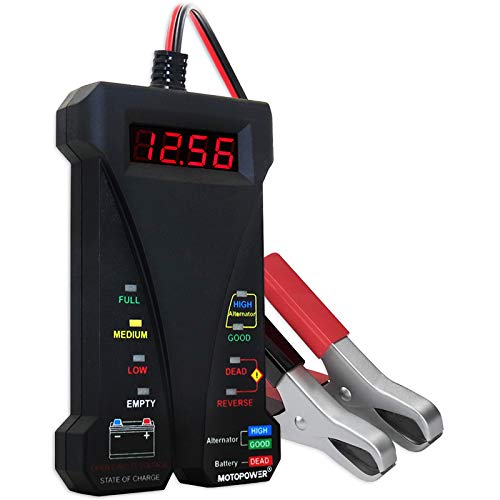
MOTOPOWER MP0514A Digital Multimeter Voltmeter with Backlit LCD
by MOTOPOWER
The cheapest way to keep a battery voltage check in the glovebox -- not a substitute for a CCA tester, but the right backup tool for a quick under-the-hood spot check before you commit to a recharge or replacement.
Pros
- Compact pocket-sized voltmeter with a 32-inch lead clips directly to the battery posts -- the right tool for a quick voltage spot check before reaching for a real conductance tester
- Backlit LCD reads cleanly in the dark or under a hood -- useful when you are diagnosing a no-start in a parking garage or driveway at night
- Reverse-polarity protection means you cannot fry the unit with a misconnect, which is the most common way budget meters die
- Over 5,000 reviews at 4.5 stars on a sub-twenty-dollar tool -- the review depth tells you it survives real glovebox abuse
Cons
- Voltage only -- this is NOT a CCA load tester, and a 12.6V reading does not tell you whether the battery has the cranking amps to start an engine
- No cranking, alternator, or chemistry-specific testing -- if you need a pass-fail health verdict on the battery, you need a real conductance tester from this list
Car Battery Tester vs. Multimeter: Which One You Actually Need
This is the most common question in the category, and the honest answer is that the multimeter in your toolbox does maybe forty percent of the job. A multimeter measures voltage — state of charge. A battery tester measures conductance — cranking capacity. Those are different physical properties, and a battery can look perfect on one and fail badly on the other.
The trap is specific and worth spelling out. Set a multimeter to 20V DC, touch red to positive and black to negative, and a fully charged healthy battery reads 12.6 to 12.8V. A sulfated battery with barely 200 usable cold cranking amps left, sitting on a car that will not start on the first cold morning of November, also reads 12.6V after a full charge. The multimeter cannot see the difference. The conductance tester can, because it measures the battery’s internal resistance and calculates actual CCA against the rating printed on the case label.
Where a multimeter genuinely earns its keep is the fast triage: check resting voltage first, and if the battery is below about 12.4V, it is discharged and needs a charge before any meaningful capacity test can happen at all. It is also the right tool — and the only tool here — for hunting a parasitic drain, which requires reading current in milliamps with the car asleep, something no conductance tester in this roundup does.
| Product | Price | Buy |
|---|---|---|
| MOTOPOWER MP0514A Digital Multimeter Voltmeter with Backlit LCDBest Multimeter for a Car Battery Voltage only. Perfect for a 5-second state-of-charge check and parasitic-drain hunting -- but it cannot tell a healthy 700-CCA battery from a dead 200-CCA one. | $11.99 | View on Amazon |
| KONNWEI KW208 12V 100-2000 CCA Car Battery TesterCheapest Real Tester The cheapest way to get past the multimeter's blind spot: real conductance CCA plus cranking and charging tests for under thirty dollars. | $29.95 | View on Amazon |
| ANCEL BA101 Professional 12V 100-2000 CCA Battery Load TesterBest Tester Overall What a multimeter can never do -- calibrated CCA against the battery's rating, stable across repeated tests, plus a full alternator check. | $36.99 | View on Amazon |
The practical recommendation: if you already own a multimeter, do not buy another one — buy the KONNWEI KW208 and use them together. The multimeter tells you the state of charge and finds drains; the tester tells you whether the battery still has the cranking amps to start the car. If you own neither and can only buy one, buy the tester. It reads voltage too.
Best Car Battery Load Tester
“Load tester” is the most abused phrase in this category, because it now describes two completely different instruments. Sorting them out is the whole job of this section.
A true load tester is a carbon-pile unit — the Schumacher BT-100 here. It applies a real, heavy current draw (100 amps on 12V) and watches the voltage sag under that load. Pass is holding above roughly 9.6V for fifteen seconds. It is the traditional test, it is physically demanding on the battery, and it needs a well-charged battery to give a meaningful result. It is also the only kind of unit here that measures starter motor current draw.
A digital “load tester” — which is what the ANCEL BA101, TOPDON BT100, and FOXWELL BT705 actually are, despite their Amazon titles — runs a conductance test instead and calculates the CCA the battery could deliver. No heavy load, no heat, no stress, works on a partially charged battery, done in fifteen seconds. This is what every dealership and every modern shop runs.
Which you want depends entirely on why you are asking. If a warranty program, an old-school shop protocol, or plain preference says you need a real load applied, buy the carbon pile. If you want the fastest, safest, most repeatable read on whether a battery still has its cranking amps — and you want to be able to test a battery that is half-flat — buy a digital conductance unit.
| Product | Price | Buy |
|---|---|---|
| Schumacher BT-100 100A 6V/12V Carbon-Pile Battery Load Tester and VoltmeterBest True Carbon-Pile Load Tester Applies a genuine 100A draw on 12V (50A on 6V) and reads the sag on an analog needle. Also measures starter motor draw, which no conductance unit here does. | $54.99 | View on Amazon |
| ANCEL BA101 Professional 12V 100-2000 CCA Battery Load TesterBest Digital Load Tester Calculates CCA from conductance in fifteen seconds with no thermal stress -- the modern shop standard, and accurate on a partially charged battery. | $36.99 | View on Amazon |
| FOXWELL BT705 12V/24V Battery Analyzer with Printer PortBest Heavy-Duty Load Tester Digital conductance across 12V and 24V, plus the alternator ripple test. The right load-test answer for a shop running diesels alongside passenger cars. | $106.99 | View on Amazon |
Technician’s Note: Do not run a carbon-pile load test on a battery reading below about 12.4V at rest. All you will learn is that a discharged battery sags under load, which you already knew, and you will have cooked a battery that might have recovered on a charger. Charge first, then load-test.
Best Car Battery and Alternator Tester
Half the “bad battery” calls I take are not bad batteries. They are bad alternators that quietly killed a perfectly good battery, and the customer replaces the battery, drives for three weeks, and comes back with the same no-start. If you buy a tester that only reads the battery, you will make that mistake at least once.
Every conductance tester in this roundup runs a charging system test: start the engine, hold about 1,500 RPM, and the unit reads the alternator’s output voltage. A healthy alternator puts out 13.5 to 14.5V at the battery. Below 13V it is undercharging, and every battery you install will slowly die. Above 15V it is overcharging, which boils electrolyte and destroys a battery even faster.
The FOXWELL BT705 goes one step further with an alternator ripple test, and this is the capability worth paying for if you diagnose electrical faults regularly. Inside every alternator is a rectifier bridge full of diodes converting AC to DC. When one diode fails, the alternator keeps charging — the voltage still looks fine — but it charges with heavy AC contamination riding on top of the DC. That AC ripple destroys the next replacement battery within weeks, and without a ripple test the only way to see it is on an oscilloscope. The BT705 catches it in fifteen seconds.
| Product | Price | Buy |
|---|---|---|
| FOXWELL BT705 12V/24V Battery Analyzer with Printer PortBest Alternator Diagnostic The only unit here with an alternator ripple test -- catches a failed rectifier diode that will destroy your next battery while still showing normal charging voltage. | $106.99 | View on Amazon |
| ANCEL BA101 Professional 12V 100-2000 CCA Battery Load TesterBest Value Battery + Alternator Tester Full charging-system output test plus battery conductance and cranking, at the price where most drivers should land. | $36.99 | View on Amazon |
| TOPDON BT100 12V 100-2000 CCA Battery TesterEasiest Alternator Readout Color health bar reports the charging system result in plain language rather than a raw voltage figure -- the easiest to act on if you are not a tech. | $47.19 | View on Amazon |
Technician’s Note: The starter is the third leg of this diagnosis and the one most people skip. A starter drawing excessive current makes the engine crank slowly, which looks exactly like a weak battery, and it shortens the life of every battery you install. The Schumacher BT-100 measures starter draw directly. If you have chased a “bad battery” through two replacements, test the starter.
Best Car Battery Charger and Tester Combo
There are really two ways to solve the test-then-charge problem, and the combo unit is not automatically the right one.
Option one: a genuine combo box. The KONNWEI KW510 tests the battery, and if the verdict is “discharged but healthy,” you start a 5-amp smart charge from the same unit without moving a clamp. It adds pulse-repair desulfation and temperature compensation. One tool, one price, one place in the toolbox. The compromise is that the tester half is thinner than a dedicated unit — 12V only, no printer, less granular reporting.
Option two: a great tester plus a great standalone charger. For roughly the same combined money you get a materially better tester and a materially better charger, at the cost of owning two things. If you already have a charger sitting on the shelf, this is obviously the answer — buy the ANCEL BA101 and be done.
My honest read: buy the combo if you own neither and want the simplest possible kit. Buy the pair if you already own a charger, or if diagnostics matter enough that you want the better instrument.
| Product | Price | Buy |
|---|---|---|
| KONNWEI KW510 3-in-1 12V Battery Charger, Tester, and Pulse-Repair MaintainerBest Charger + Tester Combo Conductance test, 5A smart charger, and pulse-repair desulfation in one box -- diagnose it, then charge it, without swapping tools. | $49.99 | View on Amazon |
| ANCEL BA101 Professional 12V 100-2000 CCA Battery Load TesterBest Tester to Pair With a Charger The better tester by a clear margin. Pair it with a dedicated smart charger from our charger guide if you want best-in-class on both halves. | $36.99 | View on Amazon |
Whichever route you take, the charging half of the job is covered in depth in our car battery charger review — and if the battery turns out to be genuinely dead rather than discharged, a portable jump starter is what gets you home.
More Car Battery Testers by Use Case
The picks above cover the main buying paths. If you arrived looking for something narrower — a purely digital unit, a shop-grade professional analyzer, a printer-equipped tester, or something that lives in a glovebox — here is the direct answer for each.
| Product | Price | Buy |
|---|---|---|
| TOPDON BT100 12V 100-2000 CCA Battery TesterBest Digital Car Battery Tester Color LCD with a percentage health bar -- the clearest digital readout here, and tied for the highest rating in the roundup. | $47.19 | View on Amazon |
| FOXWELL BT705 12V/24V Battery Analyzer with Printer PortBest Professional Car Battery Tester 12V and 24V, replaceable cables, six rating standards, and an alternator ripple test. Shop-grade in capability, not just in marketing. | $106.99 | View on Amazon |
| TOPDON BT300P 12V/24V Battery Tester with Built-In Thermal PrinterBest Car Battery Tester With Printer Built-in 57mm thermal printer hands a customer a documented test result at the counter -- the only unit here that prints without an accessory. | $79.99 | View on Amazon |
| KONNWEI KW208 12V 100-2000 CCA Car Battery TesterBest Portable / Handheld Car Battery Tester Genuinely pocket-sized with a 32-inch lead. Lives in a glovebox or roadside kit and still runs full conductance, cranking, and charging tests. | $29.95 | View on Amazon |
| ANCEL BA101 Professional 12V 100-2000 CCA Battery Load TesterBest 12V Car Battery Tester The default answer for a 12V passenger car: widest chemistry coverage in its tier, three-year warranty, and a stable reading on marginal batteries. | $36.99 | View on Amazon |
How to Test Your Car Battery Step by Step
The actual test sequence with any of the conductance testers in this roundup takes well under two minutes once you know what you are doing. Here is the procedure I use in the shop:
- Park the vehicle and let the battery rest for at least 20 minutes. This dissipates surface charge from the alternator’s most recent charging cycle. A battery just off a 30-mile commute will read artificially high until that surface charge bleeds off, and a tester reading the surface charge will give a false PASS on a marginal battery.
- Turn off everything in the vehicle. Headlights off, dome light off, infotainment off, key out of the ignition, doors closed except the one you are working from. A loaded battery cannot be tested accurately because the loads are pulling current during the test window.
- Connect the tester clamps directly to the battery posts. Red to positive, black to negative. Get a clean bite into the metal post — if the post is corroded, brush it first with a wire brush or post cleaner. A bad clamp connection returns a low CCA reading that has nothing to do with the battery’s actual capacity.
- Enter the battery’s rated CCA from the case label and select the chemistry. This is the most-skipped step and the one most likely to corrupt the result. Look on the battery case for the CCA rating in SAE format (the EN, DIN, JIS values are different scales). Pick flooded, AGM, EFB, or whichever profile matches your battery exactly. (On the analog Schumacher there is nothing to enter — skip straight to the test.)
- Run the test sequence. First the conductance test (battery health), then the cranking test (have someone start the engine while the tester is connected), then the alternator test (rev to 1500 RPM and watch the charging output). Read the results: a battery delivering above 80 percent of its rated CCA is healthy, 70-80 percent is marginal but serviceable, below 70 percent is end-of-life and should be replaced.
When NOT to Trust the Tester
There are three scenarios where a battery tester reading is unreliable and I tell customers to wait or recharge before testing:
A battery that was just jump-started. The voltage and conductance readings immediately after a jump are inflated by the surface charge from the donor battery or pack. Drive the vehicle for at least 20 minutes (or charge with a smart charger overnight) before testing — a dead battery that just got a jump will test as healthy for the first hour, then drop back to its true state.
A battery sitting below 8V. Conductance testers need at least 7 to 8 volts on the battery to run a test. Below that, the unit either errors out or returns garbage data. Slow-charge to at least 12V with a smart charger like a NOCO GENIUS, then test.
A battery that passes the CCA test today and fails again 30 days later. This pattern is the signature of advanced sulfation. The plates are accumulating sulfate crystal buildup faster than charging can dissolve it, and the battery is recovering temporarily under each charge cycle but losing capacity rapidly. The tester is reading correctly each time — the battery genuinely tests fine after a fresh charge — but the chemistry is failing. If you see this pattern, run a desulfation cycle with the KONNWEI KW510 once; if it repeats, replace the battery rather than chasing the test.
The corollary is also true: if you have a vehicle that needs a jump start more than once in a season, that is not a flaky battery, that is a failing battery that the tester can confirm in fifteen seconds.
AGM-Specific Resting Voltage Thresholds
Modern stop-start vehicles built after 2012 use AGM batteries by default, and the AGM resting voltage thresholds are different from flooded lead-acid in ways that matter when you are interpreting test results.
A flooded lead-acid battery at 12.6V resting is fully charged. An AGM battery at 12.6V is roughly 75 percent charged. The fully charged AGM resting voltage is 12.8V to 12.9V — not 12.6V. If you treat an AGM as a flooded battery and assume 12.6V means full charge, you will chronically under-charge it and accelerate sulfation.
Inversely, an AGM battery resting at 12.4V is borderline — around 50 percent state of charge — and needs immediate charging. A flooded battery at 12.4V is around 75 percent and is fine for another day or two.
Every conductance tester in this roundup has a chemistry selector that adjusts the test thresholds to match. Use it. Do not test an AGM battery on the flooded profile. If you are working off a bare voltmeter reading instead, our free car battery voltage chart has separate flooded, AGM, and lithium curves and corrects the reading for battery temperature, which is worth around 17 points of state of charge on a freezing morning and is the reason a lot of healthy batteries get condemned in January.
DIY vs Shop Pick
The fork in the road for most readers comes down to use case rather than budget:
For a home garage with one or two passenger cars: Buy the ANCEL BA101. It does everything a homeowner needs, the three-year warranty is the longest in this roundup, and the CCA accuracy is genuinely close to a professional unit at a fraction of the price.
For a working shop or a fleet that includes diesels: Buy the FOXWELL BT705. The dual-voltage 12V/24V support, alternator ripple test, and replaceable cables justify the price increment for any tech who turns wrenches for a living.
For a battery-sales counter: Buy the TOPDON BT300P. The thermal printer pays for itself in closed sales and resolved warranty disputes within weeks.
For a garage with no charger yet: Buy the KONNWEI KW510. Test, charge, and desulfate from one box.
Final Verdict
For most drivers, the ANCEL BA101 is the right answer in 2026. It runs the three-test diagnostic sequence (battery conductance, cranking, alternator) accurately on any 12V passenger car battery, the chemistry profiles cover everything except lithium, and the three-year warranty signals real manufacturer confidence. At under fifty dollars it pays for itself the first time it saves a tow or a misdiagnosed alternator job.
If you need 24V capability for diesel work or alternator ripple testing for advanced electrical diagnosis, step up to the FOXWELL BT705. If you specifically need lithium 12V starter battery support at the lowest possible price, the KONNWEI KW208 is the answer. If you want an actual carbon-pile load test rather than a calculated CCA figure, the Schumacher BT-100 is the only real one here. And keep a MOTOPOWER MP0514A voltmeter in the glovebox regardless of which tester you buy — the fifteen-second voltage spot check is the right first step before deploying a real tester. Pair whichever tester you choose with a smart charger from our car battery charger guide and a portable jump starter, and you will handle 90 percent of the battery-related no-start scenarios you will ever face without a tow truck.
Buyer's Guide
After 15 years running an independent shop, these are the six factors that actually decide whether a battery tester is worth keeping in the toolbox.
CCA Range and Battery Type Compatibility
The CCA range of the tester needs to bracket the rated CCA of the batteries you plan to test. A 100-2000 CCA range like the ANCEL BA101 covers everything from a small motorcycle battery up to a heavy-duty diesel cranking battery. More important is battery chemistry support -- a tester with only flooded and AGM profiles will give incorrect thresholds on an EFB stop-start battery or a LiFePO4 lithium starter. Verify your battery's chemistry from the case label before buying a tester, and pick a unit that lists the matching profile in its specs. Note that a CCA tester and a battery capacity tester are not the same thing: the units here report cold cranking amps and state of health, not amp-hour capacity, which only a full discharge test can measure.
Conductance Tester vs Carbon-Pile Load Tester
These are two genuinely different instruments and the word 'load tester' gets applied to both, which causes most of the confusion in this category. A conductance tester (ANCEL, KONNWEI, TOPDON, FOXWELL, Acclope) injects a small AC signal and calculates CCA from the impedance response -- fast, safe, works on a partially charged battery, and does not stress the battery. A carbon-pile load tester (the Schumacher BT-100) applies a real 100-amp draw and watches the voltage sag, which is the traditional definitive test but requires a well-charged battery and puts genuine thermal stress on it. Modern shops and dealerships run conductance. Buy the carbon pile only if you specifically want the old-school load test or need the starter-draw measurement.
12V vs 24V System Support
Almost all passenger cars are 12V, so a 12V-only tester like the ANCEL BA101 or TOPDON BT100 is sufficient for a typical home garage. If you work on Class 7 or Class 8 diesel trucks, RV chassis with 24V starting systems, or commercial equipment, you need dual-voltage 12V and 24V support -- the FOXWELL BT705, Acclope BT60 PRO, and TOPDON BT300P cover this. Buying a 24V-capable tester for a fleet of passenger cars is wasted money, but using a 12V-only tester on a 24V system will damage the unit.
Battery Chemistry Support: AGM, EFB, and Lithium
Modern stop-start vehicles built after 2012 use AGM or EFB batteries, both of which need different test thresholds than flooded lead-acid. AGM tests against a higher resting voltage baseline, EFB has a unique conductance profile, and LiFePO4 lithium starter batteries used on motorcycles and certain modified vehicles need their own profile entirely. The KONNWEI KW208 is the pick for a genuine lithium CCA reading. The Acclope BT60 PRO covers the widest voltage range but limits lithium to voltage and health checks. The MOTOPOWER MP0514A handles none of these properly because it only reads voltage. Match the tester to the battery types in your fleet.
Cranking and Alternator Load Tests
A battery tester that only runs a conductance test on the battery is missing half the diagnostic value. The cranking test measures voltage drop during engine start, which catches a battery that conducts well but cannot deliver high current under load -- common on old AGM batteries with high internal resistance. The alternator test measures the charging voltage at idle and under load, which catches a failing alternator that would kill the next replacement battery within weeks. Every conductance tester in this roundup runs all three tests, and the FOXWELL BT705 adds an alternator ripple test that no other unit here includes. The MOTOPOWER does not run any of them.
Display, Result Clarity, and Documentation
A monochrome LCD that returns raw CCA numbers is fine for a technician who knows what 540 actual CCA on a 600-rated battery means. For a customer-facing service desk or a homeowner, a color display with a percentage health bar -- like the TOPDON BT100 or BT300P -- communicates the result instantly. If you need to document results for warranty claims or fleet records, the TOPDON BT300P built-in thermal printer is the right pick, with the Acclope BT60 PRO's QR cloud report a cheaper alternative that needs no paper and no app. For pure DIY use, the simpler ANCEL display is sufficient.
Frequently Asked Questions
How accurate is a handheld battery tester compared to the one at AutoZone or my shop?
Can a battery tester find a parasitic drain that is killing my battery overnight?
Can I test an electric or hybrid car's battery with one of these?
Do I need to disconnect the battery from the car before testing it?
Can I test a completely dead battery with a conductance tester?
What is the difference between a battery tester and a multimeter?
How do I test a car battery without a tester at all?
How long should a car battery last and when should I replace it instead of recharging?
Related Articles
About the Reviewer

Mike Reeves, ASE Master Technician
A.A.S. Automotive Technology, Universal Technical Institute (UTI)
Mike Reeves is an ASE Master Technician with 15 years of hands-on experience in automotive repair and diagnostics. He earned his A.A.S. in Automotive Technology from UTI and runs his own independent shop in Denver, Colorado. Mike founded RevRated to help everyday car owners make smarter parts decisions -- every recommendation comes from real-world testing in his garage.