7 Best Dash Cams of 2026
Mike Reeves reviews the best dash cams of 2026. Compare front-only, front+rear, and premium models by resolution, night vision, GPS, and parking mode for every driver.
Updated
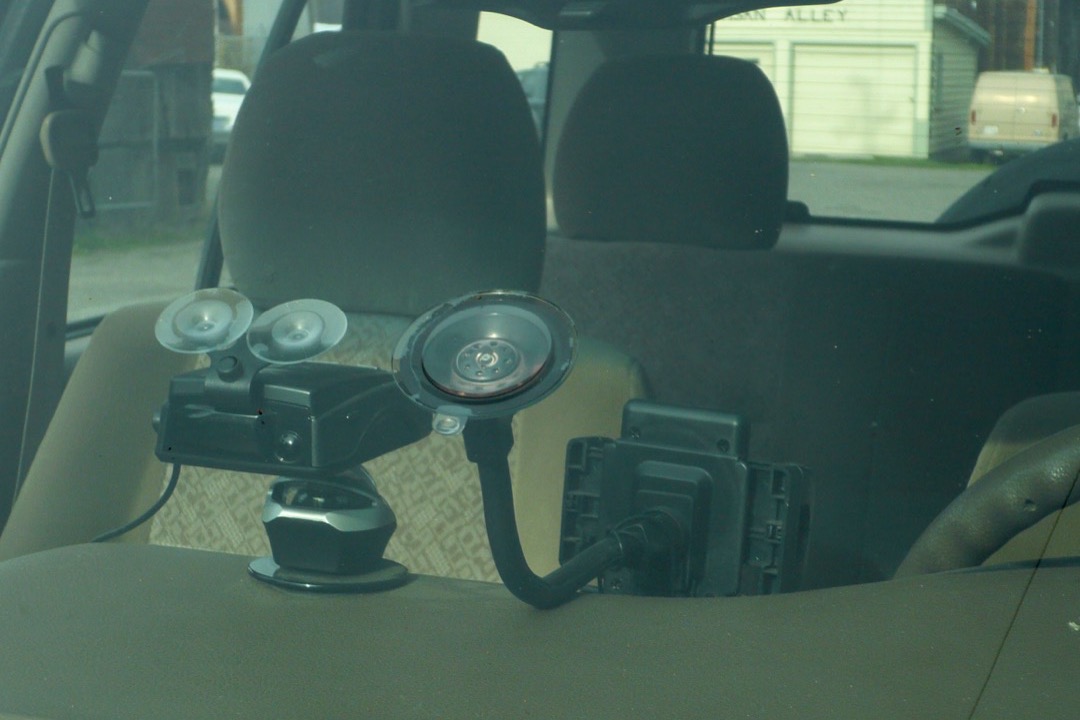
In 15 years as an ASE Master Technician, I have watched dash cams go from a niche import product to standard equipment in fleet vehicles and a serious consideration for every driver who cares about liability documentation. The reason is simple: when a collision happens or a parking lot dispute starts, the driver with footage wins. The driver without it is working from memory against someone else’s account. The best dash cams of 2026 range from a key-sized camera that nobody will ever notice on your windshield to a dual-channel system with Sony STARVIS 2 sensors on both channels — and the right choice depends on how you drive, where you park, and what level of documentation you need. The shift this year is that dual-channel front-and-rear coverage has moved from a premium upgrade to the baseline most drivers should buy, because rear footage is what settles the rear-end and lane-change disputes that front-only cameras miss entirely.
For this roundup I evaluated seven dash cams across image sensor quality, resolution, GPS accuracy, WiFi performance, parking mode capability, and storage value. I looked specifically at real-world night vision performance — because that is where cheap sensors fail and where the difference between a recognizable license plate and an unreadable blur gets decided. If you are building out your in-car toolkit more broadly, pair a dash cam with a quality OBD2 scanner so you can document both the external incident and any vehicle fault codes that result from a collision. And keep a jump starter in the trunk — cameras drain batteries in parking mode, and a jump starter covers you if a long parking mode session pulls the voltage too low before the cutoff triggers.
After evaluating real-world owner reports, sensor specifications, and footage samples across all seven cameras, here are the best dash cams of 2026.
| Product | Price | Buy |
|---|---|---|
| ROVE R2-4K DUAL PRO Dash Cam Front and RearBest Overall | $249.99 | View on Amazon |
| ROVE R2-4K Dash CamBudget Pick | $99.99 | View on Amazon |
| Garmin Dash Cam 67WPremium Pick | $199.95 | View on Amazon |
| REDTIGER F7NP 4K Dash Cam Front and RearRunner-Up | $129.99 | View on Amazon |
| Garmin Dash Cam Mini 3Runner-Up | $99.99 | View on Amazon |
| VIOFO A129 Plus Duo Dual Dash CamRunner-Up | $170.99 | View on Amazon |
| VIOFO A129 Pro Duo 4K Dual Dash CamRunner-Up | $189.95 | View on Amazon |
Find the Best Dash Cam for How You Drive
Jump straight to the pick that matches your situation:
- Best dash cams overall — our top picks reviewed
- Best 4K dash cams
- Best front and rear (dual) dash cams
- Best compact and wireless dash cams
- More by driver type: budget, parking mode
How We Chose These Dash Cams
Every camera in this roundup was selected based on a verified Amazon ASIN with an active listing, meaningful review volume relative to its launch date, named image sensor specifications, and either a significant review base validating real-world performance or documented technical credentials from an established brand. Cameras with marketing-only night vision claims and no named sensor were excluded. Cameras with inflated resolution specs paired with generic sensors that cannot deliver usable footage at those resolutions were excluded. The seven units here cover every use case from an entry-priced front-only 4K commuter camera to a dual-channel supercapacitor system built for extreme climates and professional documentation requirements.
Best Dash Cams Overall
These are the seven cameras that earned a place in this guide, each reviewed in full below. The ROVE R2-4K DUAL PRO is my best overall pick for the widest range of drivers; the use-case sections after the reviews then match specific situations — 4K resolution, front-and-rear coverage, and a discreet compact install — to the right pick from this same lineup.
Best Overall: ROVE R2-4K DUAL PRO Dash Cam Front and Rear
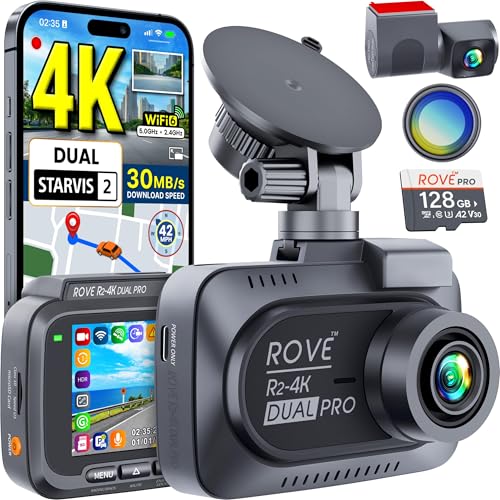
The ROVE R2-4K DUAL PRO earns the best overall designation because it is the only camera here that refuses to treat the rear channel as an afterthought — Sony STARVIS 2 sensors front and rear, a genuine 2K rear rather than the usual 1080P, 128GB storage and a CPL filter included, built-in quad-mode GPS, and WiFi 6 offload. It is the newest listing in this roundup and its review base is still in the hundreds, but the hardware is a direct upgrade of the R2-4K platform that has accumulated close to 40,000 reviews across its earlier models.
The pair of Sony STARVIS 2 sensors is the specific reason the ROVE earns the top position over similarly priced dual-channel competitors. The STARVIS 2 is Sony’s second-generation low-light sensor, and the improvement over the original STARVIS in noise reduction means the difference between footage where you can read a license plate and footage where you cannot — and here it is doing that work on the rear camera as well as the front. At 3 AM in a dark parking lot, the quality of the front sensor determines whether your footage is actually useful as evidence. The ROVE delivers on that spec in verified owner footage, not just marketing photography.
The 128GB card included is a meaningful practical advantage that gets undersold. High-endurance cards rated for continuous recording are not cheap — budget 20 to 35 dollars for a quality 128GB endurance card if you buy a camera that does not include one. The ROVE ships ready to record without that additional step. The 5GHz WiFi matters for daily footage review: if pulling clips to your phone is slow and inconvenient, you stop doing it, and then you lose footage that might have been relevant. The 5GHz band makes the download fast enough to actually integrate into a daily workflow.
ROVE R2-4K DUAL PRO Dash Cam Front and Rear
by ROVE
The most complete front-and-rear package on the market -- dual Sony STARVIS 2 sensors, a true 2K rear channel, WiFi 6 offload, and both a 128GB card and a CPL filter in the box.
Pros
- Sony STARVIS 2 sensors on both cameras -- the IMX678 front and IMX675 rear are the first pairing at this price where the rear channel is not a downgrade, so a plate behind you at night is as readable as one ahead of you
- 4K front paired with a genuine 2K rear rather than the 1080P rear that every dual camera in this price bracket ships with -- the resolution gap that made older dual cams frustrating to zoom into is largely gone
- 128GB card and a CPL filter both included in the box -- the polarizer is the accessory that removes windshield reflection and dashboard glare, and it is almost never bundled at any price
- Dual-band WiFi 6 moves footage to your phone at up to 30MB/s -- a five-minute 4K clip lands in well under a minute, which is the difference between pulling evidence at the scene and promising to send it later
Cons
- Sold at a real premium over the outgoing DUAL model -- the dual STARVIS 2 sensors and the 2K rear are worth it if night plate capture is the point, but a front-only camera covers most collisions for less than half the price
- This is a recent listing, so the review base is a few hundred rather than the tens of thousands behind ROVE's older cameras -- the hardware is a straightforward upgrade of a proven platform, but long-term field data is still accumulating
Best Budget: ROVE R2-4K Dash Cam
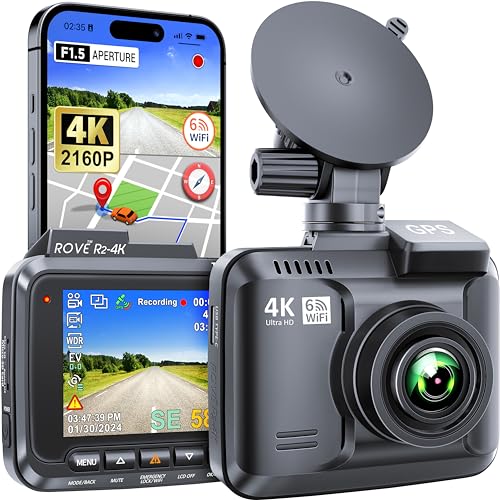
The budget pick is straightforward: the ROVE R2-4K single-channel is the most-reviewed 4K dash cam on Amazon with nearly 40,000 ratings, and it includes GPS and WiFi 6 at a price where most competitors charge more for less. If front-only coverage meets your needs — you have a garage or private parking and your primary concern is forward incident documentation — this is the clearest value in the category.
The Sony STARVIS sensor (original generation, not STARVIS 2) produces usable night footage that is meaningfully better than the generic CMOS sensors used in cheaper cameras. The difference is most visible at moderate light levels — streetlit roads, parking structures, dawn and dusk driving — where the STARVIS sensor captures detail that generic sensors turn to digital noise. In complete darkness, the gap between STARVIS and STARVIS 2 widens, but the original STARVIS still outperforms most of the competition at this price tier.
The absence of a rear camera is the only real limitation, and it is an honest one. Rear-end collisions are one of the most common incident types, and without a rear channel, you have no documentation of what the vehicle behind you was doing at the moment of impact. For city driving where rear-end risk is higher, the step up to the ROVE R2-4K DUAL PRO is worth the additional cost. For highway commuting or rural driving where rear incidents are less common, the budget single-channel is a reasonable choice. Either way, pick up a car phone mount to keep your phone accessible without obstruction — the ROVE app on your phone is how you review and download footage.
ROVE R2-4K Dash Cam
by ROVE
The most-reviewed 4K dash cam on Amazon with nearly 40,000 ratings -- built-in GPS and WiFi 6 at the lowest price of any true 4K pick here make this the clear budget choice for drivers who need front-only coverage.
Pros
- Nearly 40,000 verified Amazon reviews at 4.3 stars -- the largest review base of any 4K dash cam on Amazon, representing real-world use across virtually every vehicle type and driving condition in the US market over multiple production years
- 4K 2160P recording with built-in GPS and WiFi 6 at the lowest price of any genuine 4K camera here -- comparable cameras from name brands charge more for the same resolution tier without the GPS or wireless connectivity included
- Compact housing dimensions keep the camera behind the rearview mirror without intruding into the driver's sightline -- a common complaint with larger budget cameras is that they obstruct forward visibility, which is both a safety issue and the reason many drivers stop using them
- Sony STARVIS sensor (original generation) captures usable night footage -- not as capable as STARVIS 2 in very low light, but a meaningful step above the no-name CMOS sensors used in the cheapest cameras
Cons
- Front-only coverage means rear-end collisions and incidents happening behind the vehicle are not documented -- for city driving or highway commuting where tailgating and rear impacts are common, the lack of a rear channel is a real limitation
- No microSD card included -- you will need to purchase a card separately before the camera is functional; budget for a high-endurance 64GB or 128GB card rated for continuous recording
Upgrade Pick: Garmin Dash Cam 67W
The Garmin 67W is the upgrade for drivers who want more than documentation — they want a camera that actively participates in safe driving through Forward Collision Warning, Lane Departure Warning, and a 180-degree field of view that no other camera in this roundup can match. At the upgrade price, you are paying for Garmin engineering, the FCWS/LDWS driver alert system, and Garmin Vault cloud backup — not just a wider lens.
The 180-degree field of view is genuinely differentiated at this price tier. At 170 degrees — where most cameras top out — you capture everything in the forward cone of travel. At 180, you add the door mirrors and the first few feet of lateral visibility, which is relevant in intersection scenarios where a vehicle entering from the side is the hazard. In a lane-change dispute where the other driver claims you cut them off, having mirror-area coverage documented can be the difference between a clear record and a he-said-she-said outcome.
The FCWS and LDWS systems are worth noting because they use the same video feed that is being recorded — there is no separate sensor array, no additional hardware to install, and no subscription required to access the alerts. Garmin’s implementation in the 67W is conservative and well-tuned; it does not false-alarm at highway lane-change speeds the way some cheaper LDWS systems do. The practical limitation is the 16GB card included — replace it with a 128GB endurance card immediately. A 16GB card at 1440P high bitrate is a roughly 90-minute loop, which is not enough buffer time to catch an incident that happened during a longer drive.

Garmin Dash Cam 67W
by Garmin
The premium front-only choice for drivers who want the widest possible field of view, active driver safety alerts, and Garmin Vault cloud backup -- the 180-degree lens and FCWS/LDWS system justify the step up.
Pros
- 180-degree field of view is the widest of any camera in this roundup -- at 170 degrees, you capture nearly everything in front of the car; at 180, you capture the full width of your lane plus the door mirrors, which matters in lane-change and intersection-entry disputes where lateral coverage is the difference between documented and undocumented
- Forward Collision Warning and Lane Departure Warning systems use the dash cam's video feed as the sensor input -- this is not a gimmick at Garmin's engineering level; the FCWS triggers reliably in real traffic conditions and the LDWS is tuned to driver behavior rather than false-alarming on every lane change
- Garmin Vault cloud automatically backs up footage to the cloud when the camera is within range of a known WiFi network -- a collision that destroys or ejects the camera does not destroy the evidence if the last upload captured the event
- Voice control responds to commands like 'OK Garmin, save video' or 'OK Garmin, take a photo' without requiring the driver to interact with the camera physically -- relevant when something happens and you want to save the clip immediately without touching the device
Cons
- Front-only at the upgrade price tier -- the Garmin 67W costs more than the ROVE dual-channel and REDTIGER dual-channel while covering only the front of the vehicle; drivers who want rear coverage at this price need to add a Garmin rear camera separately
- 16GB microSD card included is undersized for continuous 1440P recording -- a 16GB card fills in roughly 90 minutes at high bitrate and begins overwriting old footage; replacing it with a 128GB endurance card immediately is a practical necessity
Runner-Up: REDTIGER F7NP 4K Dash Cam Front and Rear
The REDTIGER F7NP is the direct competitor to the ROVE R2-4K DUAL PRO at nearly the same price, and the key differentiator is the touchscreen interface. The 3.18-inch touchscreen lets you navigate footage, adjust settings, and review clips directly on the camera without pairing a phone or opening an app. In the specific scenario where you need to pull a clip immediately — at an accident scene, before a tow truck leaves, or while a parking lot security guard is waiting — the touchscreen is faster and more reliable than any app-based workflow.
The 25,000-plus reviews at 4.2 stars is a meaningful data point for a dual-channel camera in a category where review manipulation is common. At that volume, the rating represents a statistically robust sample of real-world owner experience. The F7NP’s review pattern shows consistent satisfaction with image quality and GPS accuracy, with complaints concentrated on the same heat sensitivity issues that affect most dash cams in extreme-summer climates. If you park outdoors in Phoenix or Las Vegas in July, heat management is a real consideration for any camera at this price; the VIOFO A129 Plus Duo’s supercapacitor is the right answer for extreme-heat deployments.

REDTIGER F7NP 4K Dash Cam Front and Rear
by REDTIGER
The best runner-up for front-and-rear coverage -- the touchscreen interface, 25K-plus reviews, and 128GB included storage make the REDTIGER F7NP a compelling alternative to the ROVE at the same price.
Pros
- 3.18-inch touchscreen interface lets you navigate menus, review footage, and adjust settings directly on the camera without opening an app -- on a freezing morning when you need to pull a clip before the tow truck leaves, touch access beats fumbling with a phone app every time
- 25,000-plus Amazon reviews at 4.2 stars across a dual-channel camera is a strong real-world validation dataset -- review manipulation is harder to sustain at that volume, and the rating reflects genuine owner experience with the product in daily use
- 128GB microSD included -- same advantage as the ROVE R2-4K DUAL PRO; you are recording on day one without a separate purchase, and the included card is rated for continuous write cycles rather than a standard card that will fail within weeks of dash cam use
- 5.8GHz WiFi and precise GPS logging with timestamp, coordinates, and speed overlaid on footage -- the GPS accuracy on the F7NP is notably precise, which matters when the precise location of an incident on a highway or intersection becomes relevant to a claim
Cons
- Rear camera is 1080P like most cameras in this category, limiting your ability to zoom in on rear plate numbers after the fact -- adequate for documenting the fact of a collision but not for capturing plates from a vehicle that clips you and drives off
- In vehicles parked in direct summer sun for extended periods, some owners report the camera overheating and pausing recording -- a common issue with any dash cam in extreme heat, but worth noting for drivers in the Southwest or anywhere summer temperatures regularly exceed 100 degrees
Runner-Up: Garmin Dash Cam Mini 3
The Garmin Dash Cam Mini 3 answers a specific question: what is the best dash cam if the camera being invisible is the primary requirement? It is the size of a car key, it sits flush against the glass behind the rearview mirror with nothing protruding into your sightline and nothing to see from outside the car, and it uploads saved clips to Garmin Vault over WiFi so the evidence survives even if the camera does not. For a leased vehicle, a driver who objects to visible hardware, or a car parked where a mounted camera would be noticed and targeted, this is the one that solves the problem.
The built-in Clarity polarizer is the detail worth paying attention to, and it is the reason the Mini 3 punches above its resolution. Windshield glare and dashboard reflection ruin more dash cam footage than low resolution does — a 4K clip with the dashboard mirrored across the middle of the frame is worse than a clean 1080P one. Garmin builds the polarizing filter into the lens rather than selling it as a 30-dollar accessory, so the Mini 3 is doing glare control that most cameras here do not do at all.
Be clear about the trade, though, because it is a real one. The Mini 3 has no GPS — no speed, no coordinates, no route data written into the file — and 1080P at 140 degrees is the least coverage in this roundup. If footage is going to an insurer or an attorney, the metadata matters and you want one of the GPS-equipped cameras above instead. The Mini 3 is the pick when the camera being unnoticed outranks the camera being thorough. Many owners run it as a discreet second camera alongside a full-featured primary, which is exactly what the Garmin Drive app’s multi-camera view is built for.

Garmin Dash Cam Mini 3
by Garmin
The stealth pick, and the only camera here that genuinely disappears on the windshield -- key-sized, polarizer built in, and Vault cloud backup, in exchange for 1080P and no GPS.
Pros
- Genuinely key-sized -- it tucks against the windshield behind the rearview mirror with nothing protruding into the driver's sightline and nothing visible from outside the car, which is the whole point when you want documentation without advertising that the vehicle is filming
- Built-in Garmin Clarity polarizer lens is standard rather than a bolt-on accessory -- windshield glare and dashboard reflection are the two things that most often ruin an otherwise usable clip, and every other camera here either omits a polarizer or charges 20 to 40 dollars for one
- Garmin Vault uploads saved clips over WiFi automatically, so a camera that gets destroyed, stolen, or ejected in a collision does not take the evidence with it -- the footage is already off the device
- Sold and shipped by Amazon directly rather than through a third-party reseller, and rated to handle direct sun and hot cabin temperatures -- for a camera that lives on a windshield year-round, both of those matter more than a spec sheet line
Cons
- No GPS at all -- there is no speed, coordinate, or route data embedded in the footage, which is the single biggest functional gap versus every other camera in this roundup and the reason it is a stealth pick rather than an evidence-first pick
- 1080P front-only at 140 degrees is the lowest resolution and narrowest view here, and the remote live-view and parking notification features require a paid Vault subscription on top of the purchase price
Runner-Up: VIOFO A129 Plus Duo Dual Dash Cam
The VIOFO A129 Plus Duo makes one claim that the other dual-channel cameras here cannot: Sony STARVIS sensors on both the front and the rear camera. Every other dual system in this roundup puts the good sensor up front and a cheaper one out back. This is the camera for drivers who need the rear channel to be genuinely usable for low-light plate capture rather than just proof that a collision occurred.
The practical scenario is a rear-end hit at night where the at-fault driver leaves. With a typical dual-channel camera the rear footage documents that you were struck but not by whom — the plate is a smear. With STARVIS on the rear as well as the front, you get the same class of night sensitivity looking backward as forward. The 60fps front channel compounds it: at 1440P/60 you get twice as many frames of a car crossing your field of view as a 30fps camera gives you, and plate legibility is often decided by whether any single frame caught it cleanly.
The supercapacitor is the other reason this one earns a slot. Lithium batteries in dash cams degrade in heat, and a camera that spends its summers on a windshield in direct sun is the worst case for that chemistry. Supercapacitors cycle in heat and cold without meaningful capacity loss, which is why fleet installs specify them. One honest caveat: this is VIOFO’s previous-generation platform. The current A229 line is no longer listed on Amazon US, and what remains of VIOFO here is the mature A129 series sold through specialist resellers. That is a proven camera with more than 3,000 reviews behind it rather than a current flagship, and the price should be read in that light.

VIOFO A129 Plus Duo Dual Dash Cam
by VIOFO
The pick when the rear channel has to be as good as the front -- Sony STARVIS on both cameras, 1440P at 60fps up front, and a supercapacitor that outlasts lithium in a hot parked car.
Pros
- Sony STARVIS sensors on both the front and rear cameras -- every other dual-channel camera in this roundup puts the good sensor up front and a cheaper one on the rear, so this is the pick when footage of what happened behind you needs to be as usable as footage of what happened ahead
- 2K 1440P at 60fps on the front channel, and the doubled frame rate is what makes the difference on fast-moving plates -- at 30fps a car crossing an intersection smears between frames, at 60fps you get twice as many chances at a legible still
- Supercapacitor power system rather than a lithium battery -- supercapacitors shrug off the heat cycling that swells and kills battery-based cameras parked in summer sun, which is why fleet and commercial installs specify them
- Built-in GPS logs speed, route, and coordinates into the footage, and dual-band 5GHz WiFi pulls clips to the VIOFO app without pulling the card -- the metadata insurers and attorneys actually ask for
Cons
- No microSD card included at a price where the ROVE and REDTIGER both bundle 128GB -- budget another 20 to 35 dollars for a high-endurance card before the camera records anything
- This is VIOFO's previous-generation platform, not its current one, and it is sold through a specialist reseller rather than by VIOFO directly -- the hardware is proven across 3,000-plus reviews, but you are buying a mature product rather than a new one
Runner-Up: VIOFO A129 Pro Duo 4K Dual Dash Cam
The VIOFO A129 Pro Duo is the parking-protection pick, and its buffered parking mode is the single feature on this page I would most want on a car that lives on the street. Most cameras start recording at the moment of impact, which produces a clip of a bang and an empty frame. The A129 Pro Duo holds a rolling buffer and saves 15 seconds before the event plus 30 seconds after, so you get the vehicle rolling in, making contact, and leaving. In a hit-and-run that is the difference between knowing you were hit and knowing who hit you.
The front channel is genuine 4K at 30fps on an 8MP Sony IMX317 behind a seven-element F1.8 glass lens. The aperture number is what matters after dark — F1.8 gathers meaningfully more light than the F2.0 optics common at this price — and glass elements rather than plastic keep the corners of the frame sharp, which is where plates usually sit when a car is beside you rather than in front of you. There is also a switchable 2K 60fps mode, so you can trade resolution for frame rate depending on whether plate detail or fast motion is your priority. Nothing else in this roundup gives you that choice.
Two honest caveats. The rear camera is 1080P on an IMX291 and is clearly the junior partner here, so if rear image quality is the priority the A129 Plus Duo above is the better buy despite its lower front resolution. And as with the A129 Plus, this is VIOFO’s previous-generation hardware sold through a reseller rather than the brand’s current lineup — buy it for the parking buffer and the front optics, which remain excellent, not on the assumption that it is the newest thing VIOFO makes.

VIOFO A129 Pro Duo 4K Dual Dash Cam
by VIOFO
The parking-protection pick -- true 4K on an 8MP Sony sensor with an F1.8 glass lens, and a buffered parking mode that captures the 15 seconds before an impact rather than starting at the bang.
Pros
- Buffered parking mode is the real reason to buy this one -- it holds a rolling 15 seconds before the impact and 30 seconds after, so you get the vehicle approaching and leaving rather than a clip that starts at the bang and tells you nothing about who did it
- Genuine 4K 2160P at 30fps on an 8MP Sony IMX317 sensor, with a switchable 2K 60fps mode -- you pick resolution or frame rate depending on whether you mostly need plate detail or fast-motion capture, which no other camera here lets you trade off
- Seven-glass F1.8 aperture lens with WDR -- the wide aperture is what pulls in light at night, and glass elements rather than plastic are what keep the image sharp at the edges of the frame where plates usually sit
- Dual-band 5GHz and 2.4GHz WiFi plus a GPS logger, with an optional Bluetooth remote that saves and locks a clip with one press so you are not reaching for the camera in traffic
Cons
- No microSD card included at the highest price in this roundup, and the Bluetooth remote is a separate purchase -- the real cost to get this fully running is meaningfully above the sticker
- Rear channel is 1080P on an IMX291 sensor, well behind the front -- and like the A129 Plus, this is VIOFO's previous-generation platform sold through a reseller, so it is a proven camera rather than a current one
Best 4K Dash Cams
4K is the resolution most buyers now search for, and for good reason: the extra pixels are what turn a blurry smear into a readable license plate when you zoom into the one frame that matters. All three picks here shoot genuine 4K on a named Sony sensor — not the upscaled “4K” that cheap cameras advertise.
For most drivers the ROVE R2-4K DUAL PRO is the sweet spot — 4K front, a 2K rear, and storage included. If parking protection is what you actually need the 4K for, the VIOFO A129 Pro Duo pairs an F1.8 glass lens with a buffered parking mode that captures the seconds before an impact. And if you only need the road ahead and want to spend the least, the front-only ROVE R2-4K delivers true 4K for roughly half the price of the dual-channel picks.
| Product | Price | Buy |
|---|---|---|
| ROVE R2-4K DUAL PRO Dash Cam Front and RearBest 4K overall 4K front and 2K rear on dual Sony STARVIS 2 sensors, 128GB card and CPL filter included -- the most complete 4K package on the market | $249.99 | View on Amazon |
| VIOFO A129 Pro Duo 4K Dual Dash CamBest 4K for parking True 4K on an 8MP Sony sensor behind an F1.8 glass lens, with a buffered parking mode that saves the 15 seconds before an impact | $189.95 | View on Amazon |
| ROVE R2-4K Dash CamBest budget 4K Front-only 4K with GPS and WiFi 6 and 39,000+ reviews -- the cheapest way into genuine 4K | $99.99 | View on Amazon |
Best Front and Rear (Dual) Dash Cams
Front-and-rear is the coverage most drivers should buy in 2026. Rear footage is what settles the rear-end collisions and lane-change disputes a front-only camera never sees — and at these prices, dual-channel is no longer a premium upgrade.
The ROVE R2-4K DUAL PRO is the best all-rounder. If rear image quality matters as much as front — documenting plates of the vehicles behind you — the VIOFO A129 Plus Duo is the only pick here with a Sony STARVIS sensor on both cameras. And the REDTIGER F7NP adds an on-camera touchscreen so you can pull a clip in freezing weather without fighting a phone app.
| Product | Price | Buy |
|---|---|---|
| ROVE R2-4K DUAL PRO Dash Cam Front and RearBest dual overall 4K front plus a genuine 2K rear with 128GB and GPS included -- the best-rounded front-and-rear system at its price | $249.99 | View on Amazon |
| VIOFO A129 Plus Duo Dual Dash CamBest dual image quality The only dual cam here with a Sony STARVIS sensor on BOTH cameras, and 1440p at 60fps up front for cleaner plate stills | $170.99 | View on Amazon |
| REDTIGER F7NP 4K Dash Cam Front and RearBest value dual 4K front and 1080p rear with an on-camera touchscreen and 128GB included -- pull clips without opening a phone app | $129.99 | View on Amazon |
Best Compact & Wireless (WiFi) Dash Cams
“Wireless” dash cam is a slightly loaded term — no consumer cam is truly cable-free, since it needs constant power to record. What buyers in this segment actually want is a compact camera that disappears at the windshield and offloads footage over WiFi instead of pulling the card. That is exactly what these two deliver.
The Garmin Dash Cam Mini 3 is the stealth pick — key-sized, invisible behind the mirror, with a polarizer built into the lens and automatic Vault upload of saved clips. If you want fast WiFi offload but need full front-and-rear coverage and GPS data, the ROVE R2-4K DUAL PRO is the WiFi all-rounder.
| Product | Price | Buy |
|---|---|---|
| Garmin Dash Cam Mini 3Most discreet / compact Key-sized and invisible behind the mirror, with a built-in polarizer and Vault cloud upload -- but 1080p and no GPS | $99.99 | View on Amazon |
| ROVE R2-4K DUAL PRO Dash Cam Front and RearBest WiFi all-rounder Full front-and-rear coverage with 5GHz WiFi, GPS and app control if you want more than a compact front cam | $249.99 | View on Amazon |
More Dash Cams by Driver Type
A few buyers are best matched to one standout attribute from the lineup above. Here is the quick reference for budget, parking protection, and driver-assist priorities:
| Product | Price | Buy |
|---|---|---|
| ROVE R2-4K Dash CamBest budget pick Front-only 4K with GPS and WiFi 6 at the lowest 4K price here -- the most-reviewed budget cam on Amazon | $99.99 | View on Amazon |
| VIOFO A129 Pro Duo 4K Dual Dash CamBest for parking protection Its buffered parking mode saves the 15 seconds before an impact, so a hit-and-run clip shows who did it | $189.95 | View on Amazon |
| Garmin Dash Cam 67WBest for driver-assist alerts 180-degree lens with Forward Collision and Lane Departure warnings plus Garmin Vault cloud backup | $199.95 | View on Amazon |
How to Choose the Best Dash Cam
Buyer's Guide
After 15 years on the job and more insurance claim conversations than I can count, these are the six factors that determine whether a dash cam actually protects you when it matters.
Front-Only vs. Front and Rear
Front-only cameras document what happens ahead of the vehicle -- forward collisions, red light running, and road hazards. Front and rear systems add documentation for rear-end impacts, parking lot incidents, and tailgating, which represent a meaningful portion of insurance claims and parking disputes. If you drive in urban areas, park on streets, or regularly deal with aggressive highway traffic, the rear channel adds protection that front-only cannot provide. For drivers with a limited budget who primarily commute on open roads and park in a garage, front-only is a reasonable trade-off.
Resolution and Image Sensor
Resolution determines how much detail is captured; the image sensor determines how well the camera handles real-world conditions like night driving, glare, and low-contrast situations. 4K delivers the most detail but requires more storage and generates larger files. 1440P is the practical sweet spot for most drivers -- meaningfully better plate capture than 1080P at a manageable file size. The sensor matters as much as the resolution number: a Sony STARVIS 2 sensor in a 1440P camera produces better low-light footage than a generic sensor in a 4K camera. When evaluating cameras, look for both the resolution spec and the named sensor -- STARVIS 2 is the current benchmark.
Night Vision Performance
The majority of incidents that require dash cam documentation happen at night or in low-light conditions -- parking lots, unlit intersections, predawn commutes. A camera that produces unusable footage after dark is not protecting you during the conditions where you most need protection. Sony STARVIS and STARVIS 2 sensors are the legitimate benchmark in the consumer dash cam segment. STARVIS 2 is a meaningful improvement over the original STARVIS in noise reduction and dynamic range. Cameras that list 'Super Night Vision' or equivalent marketing terms without naming the sensor should be treated skeptically -- the sensor name is the verifiable specification.
GPS and Speed Logging
Built-in GPS embeds location coordinates, speed, and timestamp into every frame of footage. This metadata is what makes dash cam footage genuinely useful for insurance claims and legal proceedings -- not just video of an event, but video with documented speed, location, and time that can be cross-referenced with accident reports and witness accounts. GPS also enables the speed overlay feature that shows your speed at the moment of impact in the video frame itself. For commercial drivers or anyone who regularly files claims, GPS is not optional. Single-constellation GPS is adequate; quad-satellite GPS locks faster and holds in urban canyons.
Parking Mode and Hardwiring
Parking mode monitors the vehicle when the ignition is off, either continuously at low bitrate or triggered by motion or impact events. Enabling parking mode requires a hardwire kit that connects the camera to the vehicle's fuse box rather than the cigarette lighter, drawing power from an always-on fuse and cutting off below a voltage threshold to prevent a dead battery. The hardwire kit is a straightforward installation for anyone comfortable working in the fuse box -- a 30-minute job with basic tools. For a vehicle parked in a public lot or on a street overnight, parking mode is the feature that documents hit-and-run damage and theft attempts that happen when you are not in the car.
Storage and Loop Recording
All dash cams use loop recording -- when the card fills up, the oldest footage is overwritten by the newest. The loop length at any given storage size depends on the recording resolution and bitrate. At 4K, a 128GB card stores roughly 10 to 12 hours of continuous footage before overwriting begins. At 1440P dual-channel, a 128GB card holds approximately 8 to 10 hours. The practical requirement is enough storage to cover at least 24 to 48 hours of driving. Always use a high-endurance card rated for continuous recording; standard cards fail within months of dash cam use.
Hardwire Installation: Getting the Most From Parking Mode
Every camera in this roundup supports parking mode, but the feature is only useful if you hardwire the camera rather than running it off the cigarette lighter. The cigarette lighter cuts power when the ignition is off. The hardwire kit connects the camera to the fuse box using the always-on fuse slot — the circuit that powers your clock and radio memory — along with an ignition-switched fuse for automatic on/off with the key.
The installation takes about 30 minutes on most vehicles: route the power cable along the headliner and A-pillar trim, connect the hardwire kit’s two leads to the appropriate fuses using add-a-fuse adapters, and tuck the cable under the trim. No cutting, no splicing. The low-voltage cutoff on the camera — typically settable between 11.6 and 12.0 volts — stops drawing power before the battery drops below starting threshold. For most daily-driven vehicles, parking mode at the default sensitivity setting will not affect battery health. For vehicles that sit for multiple days between starts, set the cutoff conservatively and pair it with a periodic check using a tire pressure gauge and a battery condition review — sitting vehicles need more attention across all systems, not just the camera.
Final Verdict
The ROVE R2-4K DUAL PRO is the right dash cam for most drivers. dual Sony STARVIS 2 sensors, a true 2K rear channel, 128GB storage and a CPL filter included, quad-mode GPS, and WiFi 6 offload — the value case is straightforward, and it builds on the R2-4K platform that has earned close to 40,000 reviews across its earlier models.
If front-only coverage is sufficient and budget is the primary constraint, the ROVE R2-4K single-channel budget pick delivers 4K recording with GPS and WiFi 6 at a lower price, backed by nearly 40,000 reviews. For drivers who need a camera that disappears behind the mirror, the Garmin Dash Cam Mini 3 solves the stealth requirement better than anything else here, provided you can live without GPS data in the footage. And for a car that sits on the street overnight, the VIOFO A129 Pro Duo’s buffered parking mode — which saves the 15 seconds leading up to an impact, not just the impact itself — is the feature most likely to turn a hit-and-run into a claim you can actually win.
Frequently Asked Questions
Does a dash cam record when the car is off?
What resolution do I need to read license plates on dash cam footage?
Do I need a front and rear dash cam or is front-only sufficient?
What microSD card should I use in a dash cam?
Can a dash cam footage be used as evidence in court or for an insurance claim?
Related Articles
About the Reviewer

Mike Reeves, ASE Master Technician
A.A.S. Automotive Technology, Universal Technical Institute (UTI)
Mike Reeves is an ASE Master Technician with 15 years of hands-on experience in automotive repair and diagnostics. He earned his A.A.S. in Automotive Technology from UTI and runs his own independent shop in Denver, Colorado. Mike founded RevRated to help everyday car owners make smarter parts decisions -- every recommendation comes from real-world testing in his garage.