8 Best Tire Pressure Gauges of 2026
Mike Reeves reviews the best tire pressure gauges of 2026. Compare digital, analog dial, and pencil gauges by accuracy, PSI range, build quality, and real-world usability.
Updated
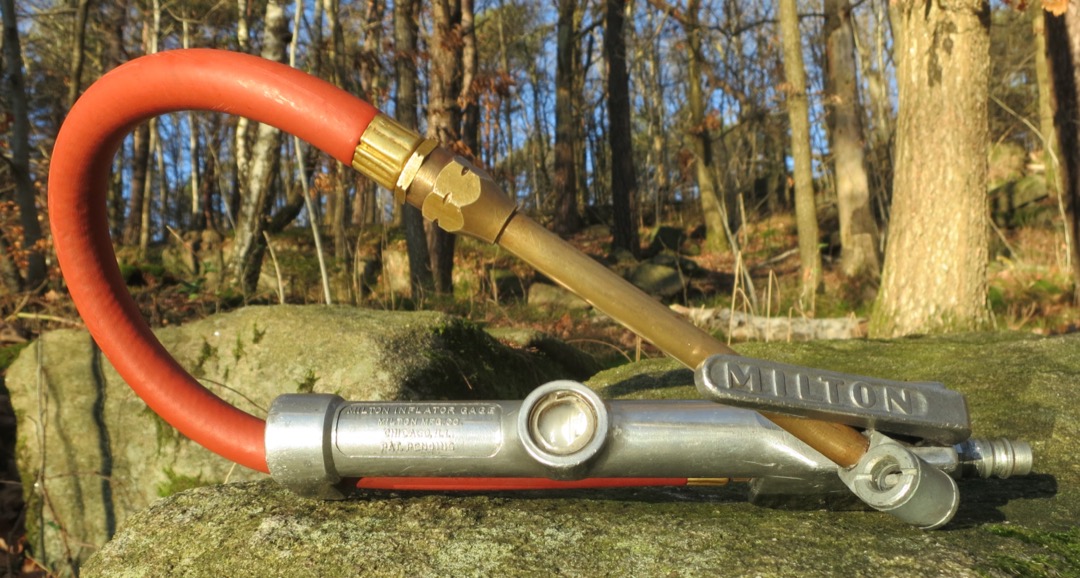
After 15 years of running an independent shop in Denver, I have checked tire pressure on thousands of vehicles. The gauge you use matters more than most drivers realize — not because cheap gauges are wildly inaccurate, but because a consistent, reliable reading is the difference between catching a slow leak early and dealing with a blowout on the highway.
Your car’s TPMS system is not a substitute. Federal law only requires the warning light to trigger at 25 percent below recommended pressure. At a recommended 32 PSI, that means your dashboard stays dark until you hit 24 PSI — a level that is already compromising handling, increasing stopping distance, and accelerating tire wear. An inexpensive gauge used once a month gives you information your car’s computer never will.
I evaluated these eight gauges across the three main categories — digital, analog dial, and pencil — testing each on passenger cars, light trucks, and a motorcycle in the shop. Here is what I found.
| Product | Price | Buy |
|---|---|---|
| JACO ElitePro Digital Tire Pressure GaugeBest Overall | $29.90 | View on Amazon |
| AstroAI Digital Tire Pressure Gauge 150 PSIBudget Pick | $6.58 | View on Amazon |
| JACO ElitePro-X Digital Tire Pressure Gauge with Lightning ChuckPremium Pick | $59.99 | View on Amazon |
| ETENWOLF T300 Digital Tire Pressure Gauge 200 PSIRunner-Up | $6.99 | View on Amazon |
| Rhino USA Heavy Duty Tire Pressure Gauge 75 PSIRunner-Up | $19.90 | View on Amazon |
| TireTek Premium Tire Pressure Gauge 60 PSIRunner-Up | $9.77 | View on Amazon |
| Milton S-920 Pencil Tire Pressure Gauge with Tread Depth GaugeRunner-Up | $16.11 | View on Amazon |
| AstroAI Heavy Duty Digital Tire Pressure Gauge 230 PSIRunner-Up | $20.98 | View on Amazon |
Find the Right Tire Pressure Gauge for Your Need
Jump straight to the pick that matches how you check pressure:
- Best tire pressure gauges overall — our top picks reviewed
- Best digital tire pressure gauges
- Best analog dial tire pressure gauges
- Best for trucks, RVs and trailers (high PSI)
- Best for bikes and motorcycles (Presta valves)
Best Overall: JACO ElitePro Digital Tire Pressure Gauge
The JACO ElitePro earned the top spot in Project Farm’s independent 26-gauge accuracy test with just 0.9 PSI total error across three pressure checkpoints. That is not marketing copy — it is a measured result from one of the most rigorous consumer testing channels on YouTube, and it matches what I see on the shop bench when I compare this gauge against my calibrated Snap-on unit.
The construction is what separates it from the dozens of sub-20-dollar digital gauges on Amazon. The body is brass and steel with a rubberized shock guard, not the hollow plastic you get from no-name imports. The 10-inch HybridFlex hose with a 360-degree swivel chuck reaches valve stems at any angle, including the recessed stems on many alloy wheels that make press-on gauges nearly impossible to use without bleeding air.
One limitation to note: it reads PSI only. If you work on European vehicles and regularly reference bar or kPa specs, you will need a conversion chart or a different gauge. For the 95 percent of American drivers who only need PSI, this is not a real drawback.
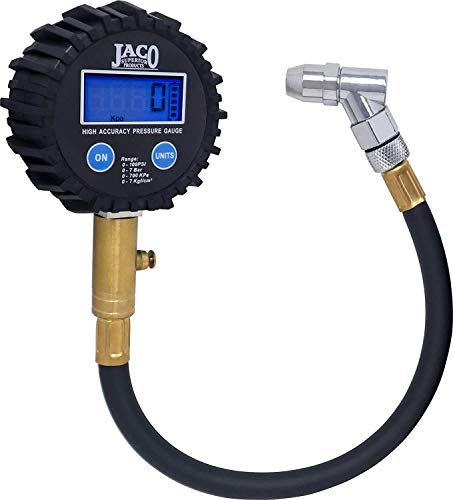
JACO ElitePro Digital Tire Pressure Gauge
by JACO Superior Products
The most accurate consumer tire pressure gauge in independent testing. ANSI Grade 2A calibration, brass-and-steel construction, and a 360-degree swivel chuck.
Pros
- Calibrated to ANSI Grade 2A at plus-or-minus 0.50 percent full scale using dual sensors -- tighter than most consumer gauges which only hit plus-or-minus 1 to 2 percent
- Solid brass-and-steel construction with a shock-resistant rubberized guard, 10-inch HybridFlex hose, and 360-degree swivel chuck
- Pressure-hold function locks the reading on-screen so you can pull the gauge away from a recessed valve stem and read it in good light
- Rated Most Accurate by Project Farm independent testing across 26 gauges and named Best Overall by both Road and Track and Car and Driver
Cons
- Reads PSI only with no bar, kPa, or kg-per-cm-squared units
- 100 PSI ceiling falls short for high-pressure trailer tires or commercial applications above 100 PSI
Budget Pick: AstroAI Digital Tire Pressure Gauge
The AstroAI has over 72,000 reviews on Amazon, which tells you something important: it works. At this volume, a fundamentally unreliable product would have been review-bombed into oblivion years ago. The 4.4-star average across that many ratings represents genuine, durable satisfaction.
What makes this gauge punch above its rock-bottom price is the feature set. Four-unit conversion with PSI, bar, kPa, and kgf-per-cm-squared covers any spec sheet. The included Presta valve adapter means it works on road bikes. The backlit LCD and illuminated nozzle tip are features that plenty of 25-dollar gauges lack entirely.
The trade-off is the LR44 coin cell battery. It is harder to find than a AAA, and some users report less than a year of life under frequent use. Keep a spare in your glovebox. The other weakness is no bleed valve — if you overshoot your target PSI at the air pump, you need to press the valve core manually to release air, which is fiddly but manageable.
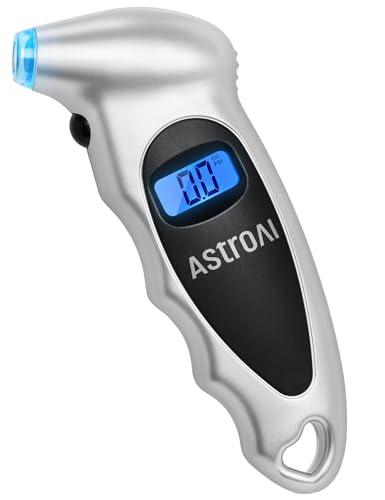
AstroAI Digital Tire Pressure Gauge 150 PSI
by AstroAI
The best value tire pressure gauge with four unit readings, a backlit nozzle, and Presta adapter for under 10 dollars.
Pros
- Over 72,000 verified ratings confirm reliable everyday performance despite the budget price point
- Reads in PSI, bar, kPa, and kgf-per-cm-squared with a Presta valve adapter included
- Backlit LCD plus illuminated nozzle tip for finding valve stems in dark conditions
- 0.1 PSI resolution for tracking subtle pressure changes from temperature shifts
Cons
- LR44 coin cells are harder to source than AAA batteries and may last less than a year under frequent use
- No built-in deflation or bleed valve for releasing excess pressure
Premium Pick: JACO ElitePro-X with Lightning Chuck
The ElitePro-X solves the single most annoying problem with tire pressure gauges: air bleed during connection. The patented Lightning Chuck locks onto the valve stem with a push-and-click motion that creates an instant airtight seal. No hissing, no fumbling, no losing 1 to 3 PSI while you try to get a stable reading. Once you use a locking chuck, going back to a press-on design feels primitive.
The aircraft-grade anodized aluminum body is lighter than the brass-heavy standard ElitePro while being more corrosion-resistant. The other half of the design is what happens when you pull off: a quick-release button drops the chuck off the stem with no air loss, and an inline bleeder on the 8-inch braided hose lets you walk a tire down to an exact figure in one hookup, reading in 0.10 PSI steps. Setting pressure stops being a connect-check-bleed-recheck loop.
Note the review base is still thin — a few dozen ratings against the standard ElitePro’s seven thousand — so long-term durability data is thinner than the badge suggests. At its premium price, this gauge is also hard to justify purely on accuracy: the standard ElitePro reads just as precisely for passenger vehicles. You are paying for the locking chuck, the lighter body, and the storage pouch. For enthusiasts who check pressure weekly or track-day drivers who need fast, repeatable readings across four tires, the premium is worth it. For monthly driveway checks, save the money and buy the standard ElitePro.

JACO ElitePro-X Digital Tire Pressure Gauge with Lightning Chuck
by JACO Superior Products
The premium evolution of the ElitePro with a patented locking chuck that eliminates air bleed during readings -- aircraft-grade aluminum and ASME 2A accuracy for enthusiasts who want zero-compromise repeatability.
Pros
- Patented Lightning instant-locking air chuck eliminates the hiss-and-bleed problem that can lose 1 to 3 PSI before a stable reading
- Anodized aircraft-grade aluminum alloy body is lighter than brass while remaining impact- and corrosion-resistant
- Includes a heavy-duty padded storage pouch that protects calibration accuracy between uses
- Quick-release button detaches with no air loss, and an inline bleeder on the 8-inch braided hose sets an exact PSI in one hookup
Cons
- Newer model with a thin review base of about five dozen ratings versus the standard ElitePro's 7,000-plus -- long-term durability data is still accumulating
- Premium price near 60 dollars is hard to justify for monthly-check-only drivers -- the standard ElitePro at half the price delivers near-identical accuracy
ETENWOLF T300: The Versatility Pick
The T300 covers the widest pressure range in this roundup at 3 to 200 PSI, which is genuinely useful if your household includes passenger cars, a truck with trailer tires, and bicycles. Most gauges force you to choose between precision on the low end and range on the high end. The ETENWOLF manages both with ANSI Grade 2A calibration and an AI thermal-compensation chip that corrects for temperature drift from minus 4 to 130 degrees Fahrenheit.
The vivid orange housing is not just cosmetic — it is immediately visible in a cluttered glovebox or dark wheel well. AAA batteries are the right choice here, being the most universally available format when you need a replacement at a gas station at midnight. This gauge competes directly with the AstroAI on price while offering substantially better range and thermal stability.

ETENWOLF T300 Digital Tire Pressure Gauge 200 PSI
by ETENWOLF
The widest-range gauge at 3 to 200 PSI with thermal compensation and ANSI Grade 2A calibration.
Pros
- 3 to 200 PSI range with Grade 2A accuracy covers passenger cars, light trucks, and air compressor hoses
- AI thermal-compensation chip corrects for temperature drift from minus 4 to 130 degrees Fahrenheit
- Standard AAA batteries are the most universally available format
- Vivid orange casing with nozzle-tip light is highly visible in dark conditions
Cons
- No built-in bleed valve for pressure relief
- Bulkier profile than compact stick or slim digital gauges
- Presta valve adapter sometimes missing from the box despite being listed as included
AstroAI Heavy Duty 230 PSI: The High-Range Pick
If your driveway has a truck, an RV, a travel trailer, or a dually pickup parked in it, a 100 PSI gauge is the wrong tool. Trailer tires routinely spec 65 to 80 PSI, motorhome tires run 80 to 110 PSI, and a gauge that tops out at 100 either pins the needle or refuses to read. The AstroAI Heavy Duty solves that with a 0 to 230 PSI range that covers everything from a 32 PSI compact car to a fully loaded fifth wheel, and it does it with ANSI B40.7 Grade 2A accuracy rather than the loose tolerances most high-range gauges settle for.
Two features make it more than a spec sheet. The stainless-steel body shrugs off the toolbox abuse that cracks plastic housings, and the LED flashlight built into the nozzle is genuinely useful the first time you find yourself checking RV tires at a dark campsite or crouched at a roadside shoulder after dark. With more than 15,000 reviews holding a 4.6-star average, it has the real-world track record to back the durability claim.
The honest trade-offs: the hose is a touch short for reaching the inner valve stems on a semi’s dual rear axle without an extension, and stretching the scale to 230 PSI costs a little resolution at passenger-car pressures compared to a dedicated low-range gauge. For a multi-vehicle household that needs one gauge to read them all, those are easy compromises.

AstroAI Heavy Duty Digital Tire Pressure Gauge 230 PSI
by AstroAI
The widest-range gauge in this roundup and the one to own if you run a truck, RV, or trailer -- 0 to 230 PSI, a built-in flashlight, and a stainless body backed by 15,800-plus reviews.
Pros
- 0 to 230 PSI range reads RV tires at 65 to 110 PSI, trailer tires at 50 to 80 PSI, and dually-truck tires that a standard 100 PSI gauge physically cannot measure
- Integrated LED flashlight in the nozzle finds the valve stem on a dark RV campsite or roadside shoulder -- a genuinely useful feature the premium gauges skip
- ANSI B40.7 Grade 2A calibration at plus-or-minus 0.5 percent full scale with a stainless-steel body that outlasts the typical plastic housing
- Over 15,800 reviews at 4.6 stars make it one of the most-validated heavy-duty gauges on Amazon -- a true do-everything gauge for multi-vehicle households
Cons
- Hose is shorter than ideal for reaching the inner valve stems on a semi-truck dual axle without an extension
- 230 PSI scale is slightly less precise at passenger-car pressures than a dedicated 0 to 60 PSI gauge with a compressed low-end scale
Rhino USA Heavy Duty: Best Analog Gauge
If you want a gauge that will work flawlessly in 10 years without ever changing a battery, replacing a screen, or worrying about electronic drift, the Rhino USA is the answer. The 2-inch glow-in-the-dark dial reads clearly in any light condition, and the braided stainless steel hose with a solid brass 360-degree swivel chuck is built to a standard that most digital gauges cannot match at any price.
Analog gauges are inherently simpler — there is no circuit board to fail, no firmware to glitch, no battery to die at the worst possible moment. The trade-off is resolution. Where a digital gauge reads to 0.1 PSI, the Rhino’s needle resolves to about 1 to 2 PSI. For monthly maintenance checks on passenger vehicles, that is perfectly adequate. For track-day precision or fuel-economy optimization, go digital.

Rhino USA Heavy Duty Tire Pressure Gauge 75 PSI
by Rhino USA
The best analog gauge with a battery-free glow-in-the-dark dial and braided steel hose built to last decades.
Pros
- ANSI B40.1 certified with a large 2-inch glow-in-the-dark dial readable in any lighting condition
- Premium braided stainless hose with 360-degree solid-brass swivel chuck resists kinking in sub-zero temps
- Zero batteries means zero maintenance and zero dead-battery failures over years of trunk storage
- Unlimited lifetime warranty from a California-based family-owned business with proven replacement track record
Cons
- 75 PSI ceiling excludes truck, trailer, and RV applications requiring 80 to 110 PSI
- Analog needle resolution of about 1 to 2 PSI is less precise than digital 0.1 PSI readouts
TireTek Premium: Best Budget Analog
The TireTek earns mention for one specific reason: it is the only consumer gauge I have found that explicitly claims ANSI B40.1 Grade B certification, which is the highest accuracy standard available at the consumer level. Every unit is individually factory-tested rather than batch-sampled, which reduces the out-of-box accuracy lottery that affects other budget analog gauges.
The integrated bleed valve is the other standout feature. After inflating a tire, you can fine-tune the pressure down to your exact target PSI without disconnecting the gauge. This saves the disconnect-check-reconnect-adjust cycle that wastes time and air with gauges that lack a bleed valve. The 60 PSI ceiling limits this to passenger cars only — if you have a truck, look elsewhere.
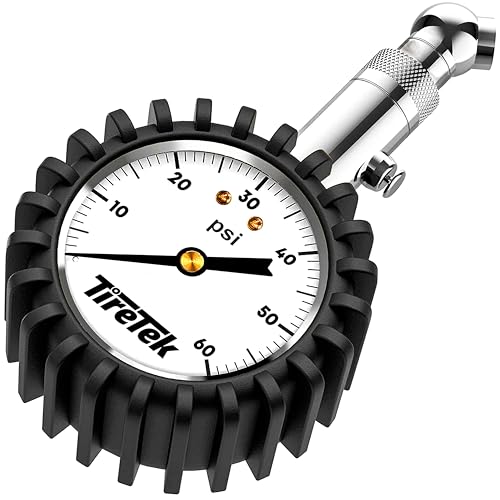
TireTek Premium Tire Pressure Gauge 60 PSI
by TireTek
The highest-certified analog gauge with ANSI Grade B calibration and a built-in bleed valve at a budget price.
Pros
- ANSI B40.1 Grade B certified and 100 percent individually factory-tested before shipment
- Steel-and-brass internals in a protective rubber housing that absorbs concrete drops
- Integrated bleed valve allows precise pressure reduction without disconnecting the gauge
- Over 9,700 reviews with customers reporting readings matching calibrated station pumps within 1 PSI
Cons
- 60 PSI cap eliminates compatibility with light trucks and any vehicle above 60 PSI spec
- Pressure needle can hold its position slightly after a reading requiring a bleed-valve tap to reset
Milton S-920: Best Pencil Gauge
Milton has been manufacturing pneumatic components since the 1930s, and the S-920 is the pencil gauge that professionals keep in their shirt pockets. Machined brass construction gives it tolerances that imported plastic pencil gauges cannot match, and the built-in deflator valve allows one-handed pressure adjustment — a feature that seems minor until you are adjusting four tires in a parking lot.
It is not the cheapest gauge here — both digital budget picks undercut it — but it is the one I would actually keep in a door pocket, because there is nothing in it to run out of battery or drift out of calibration. The other end of the barrel carries a tread depth gauge in 1/16-inch increments, which means one tool answers both questions worth asking about a tire. The 10 to 70 PSI scale also reaches light-truck pressures the older 50 PSI pencil gauges could not, and the dual PSI-kPa scale is a practical bonus for anyone who services European vehicles with kPa-labeled spec stickers.

Milton S-920 Pencil Tire Pressure Gauge with Tread Depth Gauge
by Milton Industries
The best pencil gauge in this review. Machined brass from a 90-year-old brand with a built-in deflator and a tread depth gauge on the opposite end.
Pros
- Made in the USA from machined plated brass with tighter tolerances than imported pencil gauges
- Built-in deflator valve for one-handed pressure adjustment without removing the gauge
- Pocket-sized and under an ounce with nothing electronic to fail or corrode in 10-plus years
- Integrated tread depth gauge in 1/16-inch increments plus a dual PSI-kPa scale for European spec stickers
Cons
- 70 PSI maximum covers cars and light trucks but still excludes RV and dually fitments at 80 to 110 PSI
- Nylon indicator bar is difficult to read in low light without a flashlight
- Requires precise perpendicular engagement on the valve stem or air bleeds and reading drops
Best Digital Tire Pressure Gauges
Digital gauges win on resolution — a 0.1 PSI readout lets you track the small temperature-driven changes that an analog needle rounds away — and the three below cover the full spread from accuracy benchmark to value buy.
| Product | Price | Buy |
|---|---|---|
| JACO ElitePro Digital Tire Pressure GaugeMost accurate overall 0.9 PSI total error in Project Farm's 26-gauge test -- the digital accuracy benchmark, in brass-and-steel with a swivel chuck | $29.90 | View on Amazon |
| JACO ElitePro-X Digital Tire Pressure Gauge with Lightning ChuckPremium locking chuck Patented Lightning push-lock chuck seals with zero air bleed for repeatable, track-day-grade readings | $59.99 | View on Amazon |
| AstroAI Digital Tire Pressure Gauge 150 PSIBest value 72,000-plus reviews, a four-unit display, and a Presta adapter for under ten dollars | $6.58 | View on Amazon |
Best Analog Dial Tire Pressure Gauges
If you would rather never change a battery, a dial gauge reads instantly in any light and stores for years without attention. Both of these are ANSI-certified with a glow dial.
| Product | Price | Buy |
|---|---|---|
| Rhino USA Heavy Duty Tire Pressure Gauge 75 PSIBest dial gauge Battery-free 2-inch glow dial on a braided-steel hose with a solid-brass swivel chuck -- built to last a decade in the trunk | $19.90 | View on Amazon |
| TireTek Premium Tire Pressure Gauge 60 PSIBest budget dial with bleed valve ANSI B40.1 Grade B, individually factory-tested, with a built-in bleeder to dial in an exact PSI in one connection | $9.77 | View on Amazon |
Best Tire Pressure Gauges for Trucks, RVs and Trailers
Anything that tows or carries weight runs higher pressures than a passenger car, and a 100 PSI gauge cannot read them. These two reach the 80-to-110 PSI band that trailers, RVs, and dually trucks live in.
| Product | Price | Buy |
|---|---|---|
| AstroAI Heavy Duty Digital Tire Pressure Gauge 230 PSIBest for trucks and RVs 0-230 PSI reads RV, trailer, and dually-truck tires a 100-PSI gauge can't, with a built-in flashlight for dark campsites | $20.98 | View on Amazon |
| ETENWOLF T300 Digital Tire Pressure Gauge 200 PSIWidest range (3-200 PSI) Thermal-compensated digital spanning passenger cars to 200-PSI truck tires, with a Presta adapter for bikes too | $6.99 | View on Amazon |
Best Tire Pressure Gauges for Bikes and Motorcycles
Two-wheel duty adds two requirements: a Presta adapter for road bikes and enough range for the 80-to-130 PSI road tires run. These three cover bikes, motorcycles, and the car in one box.
| Product | Price | Buy |
|---|---|---|
| AstroAI Digital Tire Pressure Gauge 150 PSIBest for bikes (Presta adapter) Includes a Presta adapter and reads four units -- works on road, hybrid, and kids' bikes plus the car | $6.58 | View on Amazon |
| ETENWOLF T300 Digital Tire Pressure Gauge 200 PSIHigh-PSI road bike tires 3-200 PSI covers high-pressure road-bike tires that top out above a car gauge's range | $6.99 | View on Amazon |
| Milton S-920 Pencil Tire Pressure Gauge with Tread Depth GaugePocket backup Pocket-sized machined brass reading to 70 PSI, with a tread depth gauge on the other end and nothing to break in a saddlebag | $16.11 | View on Amazon |
How to Choose the Right Tire Pressure Gauge
The decision comes down to how often you check pressure, what vehicles you own, and whether you prioritize precision or simplicity. Two additional points are worth addressing beyond the specification comparison.
First, gauge accuracy degrades over time. Digital gauges experience electronic drift. Analog gauges lose calibration from drops and temperature cycles. Even the best gauge should be cross-checked against a known reference every year or two — the calibrated air machine at a tire shop is a free way to verify. If your gauge consistently reads 2-plus PSI different from the shop machine, it is time for a replacement.
Second, the best gauge is the one you actually use. A pocket pencil gauge checked monthly catches the slow leak that a premium digital sitting in a drawer never will. Buy a gauge that fits your routine, keep it accessible, and build the habit of checking cold tires once a month and before any road trip. Your tires, your fuel bill, and your safety all depend on it.
If your door-jamb sticker lists pressure in bar or kPa instead of PSI — standard on most German, Italian, and Japanese cars sold in the US — run the number through our free bar to PSI converter before you set pressure. The common rounding shortcuts can leave you a few PSI off spec: 2.5 bar is exactly 36.26 PSI, not 35, and 3 bar is 43.51 PSI, not 30. A good gauge does not help if you are aiming at the wrong number.
If your door-jamb sticker has faded or your model is missing one entirely (it happens on older off-roaders and recovered project cars), use our free recommended tire pressure lookup to pull the front/rear cold PSI from owner-manual data for 100+ US vehicles — and adjust live for today’s ambient temperature and whether you’re towing or loaded. Running non-OE tires or hauling a heavy load? Our tire pressure calculator works the load-inflation math the other way — from your loaded weight and tire load index to the minimum cold PSI per axle.
Towing changes which gauge you need. Trailer tires run at pressures a car never sees: Load Range D wants 65 PSI cold and Load Range E wants 80, and a large share of pocket gauges stop reading around 50. Check what your tires are actually rated to carry with our free trailer tire load range chart, then buy a gauge whose range covers the number on the sidewall rather than one that tops out below it.
If you are running aggressive wheel offsets or wider tires than stock, your sidewalls flex more under load and pressure becomes more critical — low PSI plus a low-offset wheel is how fender-lip rub starts. Run your setup through our free wheel offset calculator to see exactly how much your tires will poke past the fender, and our tire height & diameter calculator for the corresponding speedometer error and revs-per-mile change when the tire diameter changes too. Then check pressure weekly rather than monthly with a setup like that.
Buyer's Guide
Choosing a tire pressure gauge comes down to six factors. Here is what actually matters based on 15 years of checking pressures in the shop and on the road.
Gauge Type
Digital gauges offer the finest precision at 0.1 PSI resolution with backlighting and unit conversion. Analog dial gauges are battery-free with large readable faces. Pencil gauges are the most compact and indestructible. For most drivers a digital gauge under 30 dollars covers every need. Keep a pencil gauge as a glovebox backup.
Accuracy and Calibration
Look for ANSI B40.1 or B40.7 certification. Grade 2A means plus-or-minus 0.5 percent at full scale which equals about 0.5 PSI at 100 PSI. Uncertified gauges claiming plus-or-minus 1 PSI may actually drift 2 to 3 PSI over time. In Project Farm's 26-model test, total error ranged from 0.9 PSI to over 10 PSI across brands.
PSI Range
Match the gauge to your vehicles. Most passenger cars run 28 to 36 PSI. Light trucks and SUVs run 32 to 45 PSI. Trailer tires can reach 80 to 110 PSI. A 0 to 100 PSI gauge covers most households. If you own a truck with trailer, look for 150 to 200 PSI range.
Chuck and Hose Design
A 360-degree swivel chuck reaches valve stems at any angle including recessed stems on alloy wheels. A hose length of 10 inches or more eliminates wrist contortion. Locking chucks hold the seal hands-free so you can read without fumbling.
Durability and Build Materials
Most gauge failures come from drops not mechanical wear. Dial gauges with rubber bumpers survive waist-height concrete drops that crack bare plastic housings. Brass internals outlast aluminum which outlasts plastic. For a glovebox gauge that gets knocked around, a rubberized digital or a brass pencil gauge wins.
Readability in Real Conditions
Features that matter in a dark parking lot: backlit LCD screens, glow-in-the-dark dial faces, illuminated nozzle tips, and pressure-hold functions. A 2-inch or larger dial face is the minimum for comfortable analog reading.
Final Verdict
For most drivers, the JACO ElitePro is the gauge to buy. It is the most accurate consumer gauge in independent testing, built from professional-grade materials, and backed by a lifetime warranty. Keep an AstroAI or a Milton S-920 in the glovebox as a backup you will not think twice about buying.
If you own multiple vehicle types — passenger car, truck, bicycle — the ETENWOLF T300 offers the best versatility with its 3 to 200 PSI range. And if you prefer analog reliability with zero battery dependency, the Rhino USA is the dial gauge I would put in a trunk emergency kit and forget about for a decade.
One final note from the shop: check your tires cold, once a month, and before any road trip. That single habit will save you money on fuel, extend your tire life by thousands of miles, and keep you safer on the road than TPMS alone ever will.
Frequently Asked Questions
Is my car's built-in TPMS accurate enough or do I still need a tire pressure gauge?
When is the best time to check tire pressure and why does temperature matter?
How accurate are cheap tire pressure gauges and can I trust a 5-dollar pencil gauge?
What PSI should I inflate my tires to and where do I find that number?
How often should I check tire pressure and what happens if I do not?
Can I use a car tire pressure gauge on a bicycle or motorcycle?
Related Articles
About the Reviewer

Mike Reeves, ASE Master Technician
A.A.S. Automotive Technology, Universal Technical Institute (UTI)
Mike Reeves is an ASE Master Technician with 15 years of hands-on experience in automotive repair and diagnostics. He earned his A.A.S. in Automotive Technology from UTI and runs his own independent shop in Denver, Colorado. Mike founded RevRated to help everyday car owners make smarter parts decisions -- every recommendation comes from real-world testing in his garage.