NOCO vs Schumacher Jump Starters: An ASE Mechanic's Comparison
ASE Master Tech Mike Reeves compares NOCO vs Schumacher jump starters — lithium vs AGM, peak amps vs real cranking amps, cold-weather performance, the DSR professional line, and which brand belongs in your trunk or shop.
Updated
I have jumped more dead batteries than I can count in 22 years of turning wrenches, and the NOCO-versus-Schumacher question is the single most common spec sheet debate I hear in the customer lounge. The honest answer that bloggers writing from a desk will never give you is that both brands make excellent jump starters, both brands make mediocre ones, and the right choice depends on who you are as a buyer — not which brand has the louder marketing this quarter.
This guide breaks down both company’s full product lines — not just the one headline model each competitor picks. I’ll cover how the batteries actually work, why peak amps are a marketing number and cranking amps are the real number, where lithium falls short and where AGM falls short, the professional Schumacher DSR line that consumer reviewers barely mention, and a mechanic’s use-case framework that will tell you which specific model to buy in about 60 seconds. If you want the full roundup across every category and budget, the complete best jump starters guide covers winter-specific units, diesel-capable packs, ultracapacitor options, and more.
Quick Verdict
NOCO wins for compact consumer use. Schumacher wins for multi-function value and professional shop duty. They are not really direct competitors in every category.
That is the verdict most comparison articles avoid because it doesn’t fit a one-line headline. Both brands are right; they’re right for different buyers.
| Factor | NOCO GB / GBX | Schumacher SL (Lithium) | Schumacher DSR (AGM Pro) |
|---|---|---|---|
| Target buyer | Consumer emergency use | Consumer + multi-tool | Professional shop / fleet |
| Battery chemistry | Lithium-ion | Lithium-ion | AGM lead-acid |
| Weight range | 2.4–7 lbs | 3–5 lbs | 18–41 lbs |
| Multi-function (inflator/inverter) | No (USB only) | Yes (many models) | No (focused) |
| Cable gauge | 6-gauge or lighter | 6-gauge | 2-gauge or 4-gauge |
| Cold-weather performance | Moderate (throttles below 0°F) | Pre-Heating on new models | Excellent |
| Replaceable internal battery | No | No | Yes |
| Realistic service life | 3–5 years consumer use | 3–5 years consumer use | 8–12 years shop use |
| Price range (2026) | $80–$370 | $65–$130 | $300–$700 |
Understanding the Product Lines Before You Compare
Every comparison I’ve read online picks one NOCO model (usually the GB40) and one Schumacher model (usually the SJ1329 or SL1562) and treats that as the head-to-head. That’s like comparing one Ford to one Toyota without acknowledging that each company sells a pickup, a sedan, and a sports car. Let’s actually map the full product families.
NOCO Product Lineup
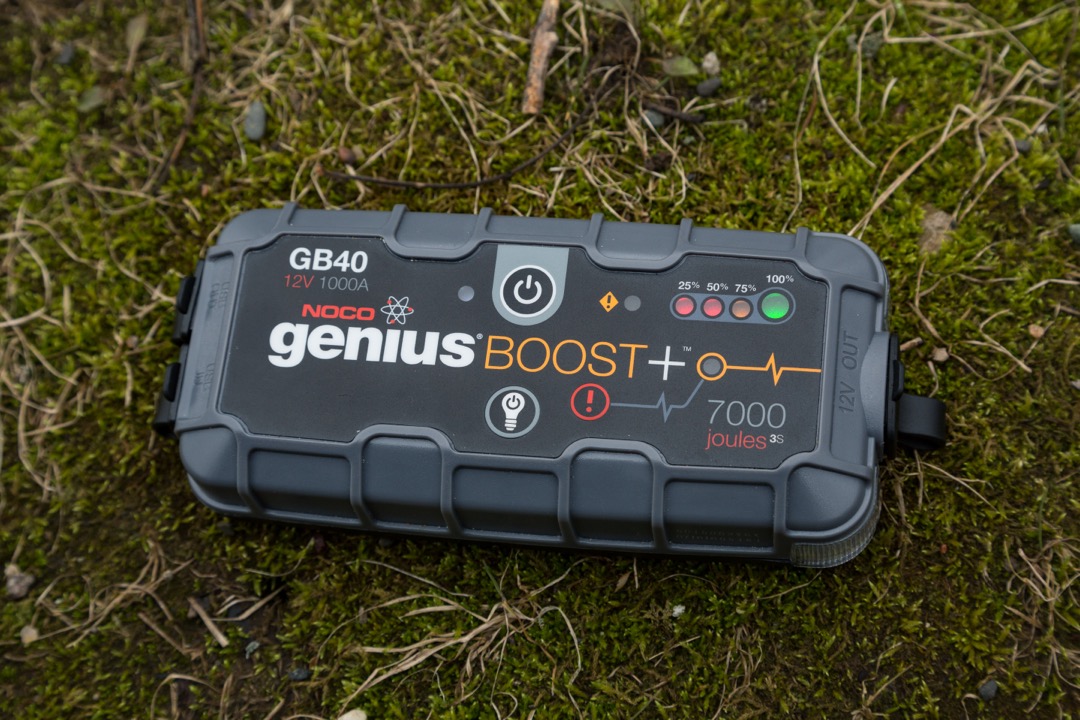
NOCO GB Series (Legacy Lithium) — The original lineup: GB20 (500A peak, ~$80), GB40 (1000A peak, ~$100), GB50 (1500A peak, ~$150), GB70 (2000A peak, ~$200). Micro-USB charging input. Proven units, in the market for years, huge installed base. The GB40 is the most-cited “starter jump starter” pick on the internet, and it earns that reputation — it’s a well-engineered product at a reasonable price.
NOCO GBX Series (Boost X Lithium) — The newer lineup that replaces and expands the GB line: GBX35, GBX45 (1250A peak, ~$100), GBX55 (1750A peak, ~$130), GBX75 (2500A peak, ~$200), GBX155 (4250A peak, ~$370). USB-C 60W bidirectional fast charging, higher output ceiling, updated BMS electronics. The GBX45 is the direct replacement for the GB40 at similar pricing. The GBX155 is a beast of a unit capable of solo-starting large diesels and even boats.
Common features across NOCO — UltraSafe spark-proof, reverse polarity protected clamps, Manual Override for deeply discharged batteries, LED flashlight with strobe/SOS modes, integrated USB-A and USB-C outputs for device charging.
Schumacher Product Lineup
Schumacher’s catalog is broader and more fragmented than NOCO’s, which is part of why bloggers oversimplify it.
Schumacher SJ Series (Consumer AGM) — Budget AGM lead-acid units. SJ1329 (600A peak, ~$65) is the entry-level pick for basic emergency use. SJ1332 (1200A peak, ~$130) adds a 200W inverter and air compressor — a multi-function unit for the trunk. AGM chemistry means heavier and bulkier than lithium but better heat tolerance and longer replaceable-battery lifespan.
Schumacher SL Series (Consumer Lithium) — SL1327 (800A peak, ~$80), SL1562 (1200A peak + 150 PSI tire inflator, ~$120), SL1648 (1250A peak, ~$130), SL1611 “Rugged” (1500A peak, rubberized housing). These are direct NOCO GB/GBX competitors at similar price points. The SL1562 is the most-distinctive unit in the lineup because the integrated tire inflator makes it a genuine multi-tool the GBX45 cannot match.
Schumacher SL1672/1673/1674 (New 2024 Lithium) — Schumacher’s answer to the cold-weather problem. 1000 to 1500A peak with Pre-Boost technology that pre-charges deeply discharged batteries before jumping, Pre-Heating technology that warms internal cells in extreme cold, and a wireless charging pad built into the housing. These units address real lithium limitations that NOCO hasn’t responded to yet.
Schumacher DSR ProSeries (Professional AGM) — The line most consumer reviews don’t mention. DSR119 (1800A peak, 280 cranking amps). DSR132 (ultracapacitor technology, 10,000-cycle rated, ECU-safe, ~$500). DSR165 (2200A peak, 525 cranking amps, 4-gauge cables, ~$400). DSR166 (4400A peak, 750 cranking amps, 2-gauge cables, 12V/24V, 41 pounds, ~$700). These are shop-floor, fleet-yard, tow-truck tools. If you’re not a professional user, you don’t need a DSR — but if you are, nothing in NOCO’s lineup competes.
Head-to-Head: The Six Things That Actually Matter
1. Peak Amps vs Cranking Amps — What the Numbers Really Mean
Every jump starter comparison I’ve read leads with peak amps as the headline spec. Peak amps is a marketing number. It’s the millisecond burst measured at 77°F in lab conditions with an ideal load. It is not the number that starts your engine.
The number that starts your engine is sustained cranking amps, which is typically 30 to 50 percent of the peak rating at room temperature, and 50 to 70 percent lower than that in freezing conditions. So a pack advertised as 1000 peak amps usually delivers 300 to 500A of sustained cranking current in good conditions, and 150 to 350A when it’s cold.
Here’s what different engines actually need in sustained cranking current:
- Four-cylinder sedan (2.0L gas): 180–250A
- Midsize V6 (3.5L gas): 250–350A
- Full-size V8 pickup (5.3L–6.2L gas): 350–500A
- Small diesel (3.0L): 500–700A
- Large diesel (6.7L Cummins, Power Stroke, Duramax): 700–1000A
Match peak-amp spec sheet to that reality. A NOCO GB40 (1000A peak) is plenty for any gasoline passenger car. A NOCO GBX75 (2500A peak) handles full-size pickups and light diesels. For serious diesels, you want either the NOCO GBX155 (4250A peak) or, honestly, a Schumacher DSR165 or DSR166 with their heavier cables and higher sustained cranking delivery.
Schumacher DSR models publish cold cranking amps (CCA) alongside peak amps because they expect professional buyers who read specs properly. That’s a useful signal — they’re not trying to hide the real number behind a marketing number.
2. Battery Chemistry — Lithium, AGM, or Ultracapacitor
Three technologies, three different use cases. Pick the right one first; the model selection is easier after that.
Lithium-ion (NOCO GB/GBX, Schumacher SL) — Compact, lightweight (under 5 pounds typically), holds charge on a shelf for up to a year. Right for consumer glove-box use in mild-to-moderate climates. Degrades with heat, throttles in cold, limited cycle life (500–1000 cycles before meaningful capacity loss). Not replaceable when the battery dies — you replace the whole unit.
AGM lead-acid (Schumacher SJ consumer, DSR professional) — Heavier (15 to 40 pounds), bulkier, but performs closer to rated capacity in heat and cold. The AGM battery inside is replaceable at end of life — you keep the unit and swap a $60 battery. Right for professional shop use and heavy residential users who will actually cycle the pack regularly.
Ultracapacitor (Schumacher DSR132) — Not a battery. Stores energy in an electric field. Self-charges from the weak vehicle battery itself before delivering the jump, so you can never forget to charge it. Rated for 10,000 charge/discharge cycles versus under 1,000 for lithium. Inherently ECU-safe because output voltage is capped by the capacitor design. The right choice for modern shops dealing with start-stop vehicles, BMW and Volvo electrical systems, and fleets where the jump pack lives in a truck for years.
Most buyers default to lithium because the marketing is newer and louder and because that’s what NOCO sells. Lithium is right for many buyers. It is not right for all buyers.
3. Cold Weather Performance
Below 0°F, lithium chemistry has a real limitation that most marketing materials don’t discuss. The electrolyte becomes viscous, ion movement slows, and the battery management system throttles output to prevent low-temperature cell damage. A lithium pack marketed as 2500A peak might deliver 1000 to 1500A in sub-zero conditions — still plenty for most gasoline cars, not always enough for a cold-soaked diesel.
NOCO’s response to the cold-weather issue is essentially “keep the unit warm” — store it in the cabin, not the trunk, on winter nights. That’s a fair answer but it puts the responsibility on the user.
Schumacher’s 2024 SL1672/1673/1674 lithium line addresses the problem at the engineering level with Pre-Heating technology that warms the cells before the pack delivers boost current. That’s the first genuine technical response to the cold-lithium problem I’ve seen from any brand, and it works.
Schumacher’s DSR AGM units don’t have the cold problem in the first place. AGM lead-acid chemistry performs closer to its rated capacity in the cold than lithium does, though the pack itself is much heavier. In northern climate shop environments, DSR units routinely outlast lithium alternatives.
The climate verdict:
- Mild climate (Southeast, Mid-Atlantic, West Coast): Either brand’s lithium is fine.
- Hot climate (Southwest, Florida, Texas): Lithium is heat-stressed. Schumacher DSR AGM pays back in unit lifespan.
- Cold climate (Northeast, Upper Midwest, Mountain States): Schumacher SL1672-series with Pre-Heating, or Schumacher DSR AGM, or keep a NOCO lithium unit warm in the cabin.
4. The NOCO Manual Override Secret That Saves Warranty Calls
Every shop gets this call: a customer bought a NOCO jump starter six months ago, their battery finally died, they hooked up the pack, and nothing happens. The pack beeps, the lights blink, but no boost current flows. They assume the unit is broken.
Nine times out of ten, the unit isn’t broken. The dead battery is below 2 volts, and NOCO’s UltraSafe electronics require at least 2V on the target battery to activate in standard mode. UltraSafe uses that voltage to detect proper polarity and confirm a good connection. Below 2V — which happens in a car that sat for weeks, a vehicle with parasitic drain from an alarm or trunk light, or a battery that’s genuinely at end of life — standard mode refuses to connect.
The fix is Manual Override, sometimes called Force Mode or Manual Boost. On most NOCO units it’s a long-press of the boost button (usually 3 seconds) with specific LED feedback confirming override is active. Manual Override bypasses low-voltage detection and forces output.
The catch that NOCO buries in the manual: Manual Override also disables reverse polarity protection and spark-proof connection protection. You are responsible for getting the clamps on correctly because the unit will not catch a mistake. Double-check red clamp on positive terminal, black clamp on a clean unpainted ground — engine block or chassis point, not the battery negative post — before pressing Manual Override.
Every NOCO owner should know this feature exists before they need it. I’ve saved more than one customer from a frustrated return and a bad review just by explaining Manual Override on the phone.
Schumacher’s equivalent is generally called “Force Start” or similar; the concept is the same across brands that use microprocessor-controlled safety electronics. AGM packs without voltage-detection electronics don’t need this because they’ll deliver current whenever you close the circuit — which is why professional users often prefer the simpler AGM experience.
5. Cable Gauge and Clamp Quality
This is the differentiator consumer reviewers never notice because they test in a garage on a clean battery. In the field — on a corroded terminal in the rain at night, on a sidepost GM battery that doesn’t accept standard clamps, on an older truck whose terminals haven’t been cleaned in a decade — cable and clamp quality matter enormously.
Consumer lithium packs (NOCO GB/GBX, Schumacher SL) use 6-gauge or lighter cables appropriate for consumer use and spring-loaded clamps that work well on standard post terminals. The clamps can slip on heavily corroded or sidepost batteries, which is a legitimate field reliability issue.
Schumacher DSR professional units use 2-gauge (DSR166) or 4-gauge (DSR165) cables — the gauge reference makes a real difference. Thicker copper means lower resistance, which means less voltage drop across the cables under sustained cranking current. For a shop cranking a big diesel at 700A for several seconds, 2-gauge versus 6-gauge is the difference between a clean start and a long crank.
DSR clamps are “hot jaw” style — heavier spring mechanism, larger bite area, more aggressive teeth that cut through surface corrosion. They grip sidepost terminals and lugs that spring clamps can’t hold.
For consumer use on modern passenger cars, NOCO’s cables are plenty. You’ll never hit the sustained-current regime where gauge matters. For shop or fleet use on work trucks, older vehicles, and diesels with corroded terminals, DSR cable gauge is a meaningful reliability advantage.
6. Total Cost of Ownership Over Five Years
The shelf price is the wrong number to compare. Real cost of ownership includes replacement frequency, warranty support, and battery replaceability.
Consumer Lithium (NOCO GBX45 or Schumacher SL1562) — $100–$120 up front. Lithium cells typically lose meaningful capacity over 3–5 years of storage plus occasional use. Pack replaces at end of life because internal battery isn’t user-serviceable. Five-year cost: roughly the purchase price, plus maybe one replacement if you use it hard.
Consumer AGM (Schumacher SJ1332) — $130 up front. AGM cells last 5–7 years with occasional use. Internal battery is replaceable for around $60 when it fails. Five-year cost: lower than lithium on a per-year basis for moderate users, higher if the pack just sits.
Professional AGM (Schumacher DSR165) — $400 up front. AGM internal battery replaceable for $60–$80 when it wears out from heavy use. Pack itself is built to last 10+ years with normal shop use. Five-year cost: $400 plus maybe one battery swap. For a shop doing 20 jumps a week, this is dramatically cheaper than replacing three consumer packs at $120 each across the same period.
The cheapest option up front is rarely the cheapest option over five years, especially for heavy users.
Which One Should You Actually Buy? A Use-Case Framework
Skip the brand loyalty. Start with how you’ll actually use the pack.
Personal glove-box emergency, mild climate, occasional use NOCO GB40 or NOCO GBX45, or Schumacher SL1327. All three are compact lithium packs at similar price points. Flip a coin; none will disappoint.
Multi-function roadside (jump + tire inflator + USB) Schumacher SL1562. NOCO doesn’t have a competing unit with integrated tire inflation. The SL1562 is a genuine multi-tool for the trunk that also compares well on jump performance to a GBX45.
Larger vehicles (full-size trucks, V8 SUVs, light diesels) NOCO GBX75 (2500A peak) or Schumacher SL1648. Both handle big gasoline engines reliably. For light diesels in warm climates, either works; in cold climates, start thinking about the Schumacher SL1672 with Pre-Heating or stepping up to a DSR.
Cold-climate driver (Upper Midwest, Mountain West, Northeast) Schumacher SL1672/1673/1674 with Pre-Heating, or a NOCO lithium pack that you store in the cabin (not the trunk) during winter. For serious cold or diesels in winter, step to a Schumacher DSR AGM unit.
Heavy diesels (6.7L Cummins, Power Stroke, Duramax) NOCO GBX155 (4250A peak) or Schumacher DSR165 (525 cranking amps, 4-gauge cables). The Schumacher’s heavier cables are the better professional choice; the NOCO wins on portability.
Professional shop or fleet use (daily jumps, rough environment) Schumacher DSR165 or DSR166. Nothing in NOCO’s lineup matches the DSR line for shop duty — the cable gauge, clamp quality, replaceable battery, and AGM heat tolerance are all the right choices for a tool that gets used every day for a decade.
Modern fleet with start-stop systems and ECU-sensitive vehicles Schumacher DSR132 ultracapacitor. Inherently ECU-safe, rated for 10,000 cycles, self-charges from the weak battery so it’s always ready. No consumer equivalent exists.
Mechanic doing occasional side work at home Mixed — I’d personally run a NOCO GBX45 for portability (I can carry it to a neighbor’s driveway) plus a corded battery charger like the ones in the best car battery chargers roundup for longer maintenance and tender duty. The jump pack is the emergency tool; the charger is the maintenance tool.
Using a Jump Starter Correctly — The Mechanic’s Checklist
A jump starter is a legitimately powerful piece of equipment. Used correctly, it’s safe and effective. Used incorrectly, it can damage the car’s electronics, the pack, or both. The steps below apply to both NOCO and Schumacher, and to jumping from any source.
Before you clamp. Turn off the dead vehicle completely — ignition off, key out, all accessories off. Clean corrosion from the battery terminals if visible. If you can’t see clean metal where the clamp will grip, you’re going to get high resistance and a weak jump. A wire brush or a stiff shop towel handles most surface corrosion in a few seconds.
Clamp order matters. Red clamp on positive battery terminal first. Black clamp on a bare, unpainted engine ground point (an engine bracket or chassis point) — not the battery negative terminal. This reduces spark risk at the battery itself, where any hydrogen gas from a gassing battery is most concentrated. Consumer spark-proof jump packs reduce this risk but it’s still the right procedure. Walk through our free animated jump start order tool if you want to see the connection sequence visualized — it covers car-to-car, jump pack, hybrid, EV, and motorcycle scenarios with a printable wallet card you can keep in the glove box.
For NOCO: check the LED. In standard mode, you need a green LED confirming good connection before pressing boost. If you get a red or orange LED, check polarity and terminal contact. If you get no response at all, the battery is likely below 2V — this is when Manual Override is the right tool, if you’re confident your clamps are correctly placed.
Crank for no more than 5 seconds at a time. If the engine doesn’t start in 5 seconds, stop, wait 30 seconds, and try again. Continuous cranking overheats the starter motor and can damage it more than a dead battery did.
Once started, leave the jump pack connected for another 2–3 minutes. This lets the alternator begin charging the weak battery while the pack continues to support the electrical system. Then remove the black clamp first, then the red clamp, and drive the vehicle for at least 20 minutes to properly recharge the battery — not 5 minutes to the store and back.
If the vehicle dies again the next morning. The battery is at end of life, or the alternator isn’t charging, or there’s a parasitic drain. Jump-starting is a diagnosis, not a cure. A basic OBD2 scanner will pull charging-system codes, and a $20 multimeter tests alternator output across the battery terminals (13.8–14.4V with the engine running). Don’t keep jumping a battery that can’t hold a charge overnight.
The Bottom Line
NOCO makes the best compact consumer lithium jump starters on the market. Schumacher makes the best consumer multi-tool jump starters (tire inflator integration, inverter options) and the best professional shop and fleet units (DSR ProSeries AGM and ultracapacitor).
The two brands are not really competing for the same customer in every segment. They overlap in the $100 lithium consumer space — and there, NOCO has a slight edge on jump performance and build quality, while Schumacher has the edge on multi-function value. Outside that narrow overlap, Schumacher has no direct competition from NOCO in the professional shop category, and NOCO has no direct competition from Schumacher in the ultra-compact glove-box category.
Don’t let brand loyalty make the decision for you. Start with how you’ll actually use the pack — consumer emergency, multi-function roadside, cold climate, shop duty — and the right model falls out of the use case in about 60 seconds. For a broader look at diesel-capable packs, ultracapacitor units, and the best all-around picks in every price bracket, the full best jump starters roundup covers every option I’d put my name on.
And while you’re thinking about automotive emergency preparedness, a tire inflator in the trunk handles the other common roadside failure the jump pack doesn’t solve, and a set of proper jack stands matter whenever you actually work on the car — because jump-starting is one of many skills worth having, but it’s the support equipment you can trust underneath a vehicle that determines whether working on your own car is safe or stupid.
Buyer's Guide
Choosing between NOCO and Schumacher comes down to six practical factors. Match these to your vehicle, your climate, and how often you'll actually use the pack, and the right unit picks itself.
Consumer Emergency Use vs Professional Daily Use
This is the single most important question and the one bloggers never ask. Are you buying a jump starter for a once-or-twice-a-year emergency, or for regular use at a shop, on a fleet, or at home with multiple project vehicles? NOCO's GB and GBX lines are engineered for the first buyer — compact, lightweight, excellent for the glove compartment, and priced for the occasional user. Schumacher has products for both buyers: the SL and SJ lines compete directly with NOCO on consumer use, and the DSR ProSeries targets the professional user who needs to jump 20 vehicles per day for five years. A consumer NOCO used as a shop tool will fail early, not because it's a bad product but because it was never designed for that duty cycle. A Schumacher DSR bought for emergency glove-box use is overkill — 20 pounds and $400 of hardware for a job a $100 pack handles. Identify your buyer profile first; the model selection falls out of it.
Lithium vs AGM vs Ultracapacitor Battery Chemistry
Three technologies, three different use cases. Lithium-ion (NOCO GB/GBX, Schumacher SL) is compact, lightweight, holds charge well on a shelf, and is the right chemistry for consumer glove-box use in mild-to-moderate climates. AGM lead-acid (Schumacher SJ consumer, DSR ProSeries) is heavier but handles heat and cold far better than lithium, has a replaceable battery at end of life, and delivers sustained cranking current more consistently under heavy load. Ultracapacitor (Schumacher DSR132) is a category on its own — not a battery at all, it stores energy in an electric field and can self-charge from the weak vehicle battery before jumping, is rated for 10,000 cycles versus under 1,000 for lithium, and is the right choice for ECU-sensitive modern vehicles and fleets with lots of start-stop systems. Most buyers default to lithium because the marketing is newer and louder. Match the chemistry to the real use case, not the marketing narrative.
Peak Amps vs Cranking Amps — What the Numbers Mean
Every jump starter is marketed in peak amps, which is a millisecond burst measurement at room temperature under lab conditions. The number that actually starts your engine is sustained cranking amps, which is typically 30 to 50 percent of the peak rating at 77°F and 50 to 70 percent lower than that in freezing conditions. A 2000A-peak lithium pack that looks enormous on paper may deliver 400 to 600A of sustained cranking current in real use. Gasoline passenger vehicles need 200 to 400A cranking; full-size trucks and small diesels need 400 to 600A; large diesels need 600 to 1000A. The correct way to read a spec sheet is to look for cranking amps (CA) or cold cranking amps (CCA) if the brand publishes it — Schumacher DSR models publish CCA because they expect professional buyers who read specs properly. NOCO publishes peak amps and starts-per-charge. Both are legitimate, but the cranking number is the one that matches engine requirements.
Cold Weather Performance and the Lithium Drop-Off
If you drive or work in temperatures below 0°F, lithium chemistry has a real limitation that the marketing ignores. Below freezing, lithium electrolyte becomes viscous, ion movement slows, and the battery management system throttles output to protect the cells from low-temperature damage. A 2500A-peak lithium pack may deliver 1000 to 1500A in sub-zero conditions — still plenty for most cars, not always enough for a cold-soaked diesel. Schumacher's 2024 SL1672/73/74 lithium line addresses this with Pre-Heating technology that warms the cells before boost. Schumacher's DSR ProSeries AGM units don't have this limitation because AGM lead-acid chemistry delivers closer to rated capacity in the cold. If you live in Minnesota, Montana, Upstate New York, or similar snow-belt climates, weight cold performance heavily in your decision. If you live in Texas, Arizona, or the Southeast, lithium's heat vulnerability matters more than cold.
Multi-Function Features vs Dedicated Jump Pack
Schumacher's consumer line leans heavily into combined function — the SL1562 includes a 150 PSI tire inflator built into the housing; the SJ1332 adds a 200W inverter and air compressor. NOCO's philosophy is the opposite: the GB and GBX packs are dedicated jump starters with USB ports for phone charging but no tire inflator, no inverter, no power bank beyond USB. There are two ways to think about this. If you want one unit in the trunk that handles jump-starting, tire inflation, and roadside phone charging, the Schumacher SL1562 is a genuinely useful multi-tool. If you prefer dedicated tools — a quality tire inflator that lives in the trunk, plus a separate focused jump pack — the NOCO approach produces a better jump starter because the engineering budget went into jump performance, not tire inflation. I run the dedicated approach in my own truck: a NOCO GBX45 plus a dedicated tire inflator. The combined Schumacher approach is valid for space-constrained vehicles where one device has to do multiple jobs.
Cable Gauge, Clamp Quality, and Connection Reliability
This is the differentiator that consumer reviewers never notice because they test in a garage on a clean battery. In the field, on a corroded terminal in the rain at night, clamp and cable quality matter enormously. NOCO uses lighter-gauge cables appropriate for consumer use and spring-loaded clamps that work well on standard post terminals but can slip on corroded or sidepost batteries. Schumacher DSR professional units use 2-gauge or 4-gauge cables (versus the 6-gauge or lighter on consumer packs) and heavy hot-jaw clamps that bite through surface corrosion and grip sidepost terminals reliably. Under sustained cranking current on a big engine, smaller cable gauge means measurable voltage drop at the clamps — the difference between a successful start and a long crank. For consumer use on a modern passenger car, NOCO's cables are plenty. For a shop or a fleet where you'll be jumping older work trucks, diesels, and corroded-terminal batteries regularly, the heavier cables on a Schumacher DSR pay back in reliability.
Frequently Asked Questions
Which is better, NOCO or Schumacher jump starters?
Is a lithium jump starter better than an AGM jump starter?
Why did my NOCO jump starter stop working?
How many amps do I actually need to jump start my car?
Can I use a lithium jump starter in below-zero temperatures?
Related Articles
About the Reviewer

Mike Reeves, ASE Master Technician
A.A.S. Automotive Technology, Universal Technical Institute (UTI)
Mike Reeves is an ASE Master Technician with 15 years of hands-on experience in automotive repair and diagnostics. He earned his A.A.S. in Automotive Technology from UTI and runs his own independent shop in Denver, Colorado. Mike founded RevRated to help everyday car owners make smarter parts decisions -- every recommendation comes from real-world testing in his garage.