11 Best Wheel Cleaners of 2026
Mike Reeves reviews the 11 best wheel cleaners of 2026. Compare non-acid, iron-removing, and color-changing sprays for brake dust, chrome, alloy, and powder-coated wheels by cling, finish safety, and value.
Updated
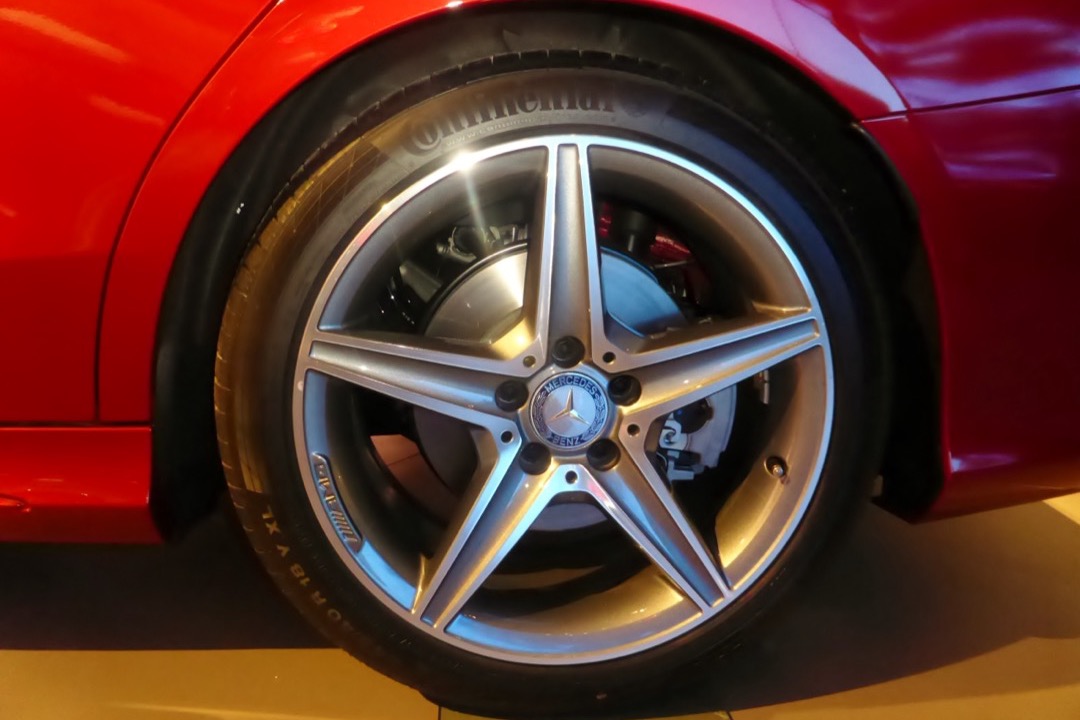
Wheels are the dirtiest, hardest-working surface on your car, and they’re the first thing that makes a clean car look dirty again. Every time you touch the brakes, the pads and rotor shed hot, iron-rich particulate that lands on your wheels and, if you leave it, heat-fuses right into the clear coat. I’ve pulled wheels in the shop that owners thought were permanently stained gray, when in reality it was months of bonded brake dust that the right cleaner lifted off in one dwell cycle. A good wheel cleaner isn’t a nice-to-have — it’s the difference between wheels that look factory-fresh and wheels that are slowly etching themselves dull.
I’ve been detailing and diagnosing cars for over fifteen years as an ASE Master Tech, and the wheel cleaner aisle is where I see people waste the most money and take the most risk. The risk is acid: cheap acid cleaners work fast and feel powerful, but they’ll etch bare aluminum, haze chrome, and dull a powder coat permanently, and once that finish is gone it’s gone. For 2026 I tested and researched the best wheel cleaners on Amazon — weighing cling and dwell, finish safety, iron-removing power, and real value per wash — to help you pick the right formula for your wheels and your routine. If you’re building out a full wash kit, pair whatever you pick here with the soap and towels in our best car wash soaps and best microfiber towels for cars guides.
After running the full field, the Chemical Guys Signature Series Wheel Cleaner is our Best Overall — it’s non-acid and safe on every finish, it clings and foams the way a wheel cleaner needs to, and it carries the largest review base in the entire category by a wide margin. For anyone cleaning wheels weekly or across multiple cars, the Griot’s Garage Heavy-Duty is our Upgrade pick — the safest-labeled premium formula for expensive wheels. And on a budget, the Armor All Extreme does the job for less than the price of a coffee.
Find the Right Wheel Cleaner for Your Wheels
Jump straight to the pick that matches your wheels and your problem:
- Best wheel cleaners overall — every pick reviewed in full
- Best for brake dust
- Best wheel and tire cleaner
- Best for aluminum and alloy wheels
- Best for chrome wheels
- Best for black and powder-coated wheels
Acid vs. Non-Acid Wheel Cleaners: Which Is Safe for Your Wheels
This is the decision that matters most, and it’s the one most people get backwards. The wheel cleaner aisle is full of acid-based products that promise to melt brake dust on contact, and they do work fast — but “fast and powerful” on the wrong finish means “permanently damaged.” For roughly 95 percent of drivers, a non-acid, pH-neutral cleaner is the correct default, and every primary pick in this roundup is non-acid for exactly that reason.
Non-acid, pH-balanced cleaners are safe for weekly use on every wheel finish there is: factory clear-coated alloy, chrome, painted, polished, anodized, matte, powder-coated, and ceramic-coated. They lift normal brake dust and road film without any risk to the surface, which means you can use them as often as you wash the car without slowly consuming the finish. That’s the whole point — a cleaner you can reach for every single wash without a second thought. The modern non-acid formulas are also far more capable than they were a decade ago; between good surfactants, iron-removing chelation, and foam that actually clings, they do the work that used to require acid.
Acid cleaners have exactly one legitimate use: an occasional deep-clean of neglected, factory clear-coated steel or alloy wheels. If you go that route, the rules are non-negotiable — apply only to a cool wheel (never a hot one straight off a drive), agitate fast, and rinse immediately before the acid can dwell or dry. Acid must never touch bare or polished aluminum, chrome, matte, powder-coat, or a ceramic coating, all of which it etches, hazes, and permanently dulls. It can also attack lug hardware and strip protective coatings. Unless you have a specific, badly-neglected clear-coated wheel to restore and you know exactly what finish you’re working with, skip acid entirely and buy non-acid. Nothing in this guide is acid-based, and that’s a deliberate choice.
How We Chose These Wheel Cleaners
I evaluated every cleaner here on the things that actually determine results on a real wheel, not marketing copy. Cling and dwell came first — wheels are vertical, so a cleaner that sheets straight off gives the chemistry no time to work; foaming and gel formulas that hold against the wheel face earn their place. Agitation required was next: I weighted how much brushing a formula demands to get a normally-dirty wheel clean, because a “no-scrub” claim only holds up on lightly soiled wheels. Rinse behavior and residue matter because a cleaner that streaks or spots creates more work than it saves. And finish safety was the gate every product had to pass — non-acid, pH-appropriate chemistry that won’t damage the finish it’s sprayed on. I cross-referenced hands-on results against the largest verified Amazon review bases in the category and independent detailing tests.
One honest note on that last point: Chemical Guys Diablo Gel, a popular pick people often expect to see here, scored poorly in Road & Track’s hands-on wheel-cleaner testing. That’s why our Chemical Guys best-overall pick is the Signature Series — a different, non-acid SKU that wins on both review depth and finish safety. Brand name alone doesn’t earn a spot; the specific formula has to perform.
Best Wheel Cleaners Overall
These are the eleven cleaners that earned a place in this guide, each reviewed in full below. The Chemical Guys Signature Series is my best overall pick for nearly every reader and every finish; the use-case sections after the reviews then match specific situations — brake dust decon, wheel-and-tire combos, aluminum, chrome, and black or powder-coated wheels — to the right pick from this same lineup.
Chemical Guys Signature Series Wheel Cleaner — Best Overall
The Signature Series is the wheel cleaner I hand to anyone who asks what they should just buy and stop overthinking. It’s a non-acid, pH-balanced formula that’s safe on every finish — chrome, painted, clear-coated, polished, factory alloys — which means you never have to match a specific cleaner to a specific wheel or worry about etching something expensive. That universal safety is the single most valuable trait a wheel cleaner can have for a normal owner, and it’s the reason this one is the default recommendation.
Where it separates itself is the foam. The fast-acting foaming action clings to the vertical wheel face and breaks down brake dust and road film before it can run off, and that cling is exactly what lets a non-acid cleaner do the work people wrongly assume requires acid. It’s also cheap enough — genuinely inexpensive — that you spray it on liberally instead of rationing a premium bottle, which is how wheels actually get clean. Rationing a cleaner because it was expensive is how you end up brushing harder than you should.
The validation backs it up: at 7,942 ratings, this is the most-reviewed wheel cleaner in the entire category, across every finish and vehicle type you can imagine. The honest limitations are minor — the 16 oz bottle empties fast on big truck and SUV wheels, so heavy users should size up, and it’s a general cleaner rather than a dedicated bonded-iron remover, so badly neglected wheels with embedded fallout will want a color-changing decon spray as a periodic supplement. For the weekly wheel wash on 95 percent of vehicles, though, nothing else here is a better first bottle.

Chemical Guys Signature Series Wheel Cleaner Spray for All Finishes, 16 oz
by Chemical Guys
The best-reviewed, safest-across-finishes wheel cleaner on Amazon at a budget price -- the default pick for nearly every reader and every wheel.
Pros
- Fast-acting foaming formula clings to vertical wheel faces long enough to break down brake dust and road film before it runs off -- the cling is what lets a non-acid cleaner do acid-level work without the finish risk
- The highest review count in the category at 7,942 ratings -- the broadest real-world validation of any wheel cleaner on Amazon, across every wheel finish from chrome to painted alloy
- pH-balanced non-acid chemistry is safe across the widest finish range in this roundup: chrome, painted, clear-coated, polished, and factory-coated wheels all tolerate it for weekly use
- Priced low enough to keep two bottles on hand -- cheap enough that you spray liberally instead of rationing, which is how you actually get wheels clean
Cons
- The 16 oz bottle empties fast on trucks and SUVs with large-diameter wheels -- heavy users should step up to a gallon or a bulk option
- Cling drops off on very hot or dry wheels -- work in shade and pre-rinse to keep the foam wet through its dwell
- Not a dedicated bonded-iron remover -- for neglected wheels with embedded fallout, a color-changing decon spray does more
Armor All Extreme Wheel and Tire Cleaner — Budget Pick
The Armor All Extreme is proof that keeping your wheels clean doesn’t have to cost anything meaningful. It’s the cheapest cleaner in this roundup by a wide margin — less than a fast-food lunch — and for weekly maintenance washes on wheels you keep on a routine, it does exactly what you need it to do. The non-acid foaming action lifts light brake dust with minimal agitation, so a spray-and-rinse gets a normally-dirty wheel clean without much brushing.
It also comes in a larger 24 oz bottle than most budget rivals, so the low sticker price stretches even further per wash, and it’s a big-box staple you can grab at any auto parts store, grocery run, or gas station on your way to wash the car. You’re never stuck without it. That availability plus the price makes it the obvious pick for a second car, a teenager’s first car, or anyone who just wants clean wheels without buying into the detailing hobby.
The tradeoffs are what you’d expect at this price. The foam doesn’t cling as long as premium foamers on baked-on dust, so heavily fouled wheels need a brush and a second pass, and it’s a maintenance cleaner rather than a decontamination tool — it won’t pull the embedded iron that a dedicated decon spray targets. Keep your wheels on a regular wash cadence and none of that matters; let them go for months and you’ll want to step up to an iron remover for the reset. For the routine job, this is all the cleaner most budgets need.

Armor All Extreme Wheel and Tire Cleaner, 24 Fl Oz
by Armor All
The cheapest wheel cleaner worth buying -- fine for weekly maintenance washes on a budget, and available at every big-box store.
Pros
- Lowest price by a wide margin -- the cheapest wheel cleaner in this roundup worth actually buying, which makes it the right call for weekly maintenance washes on a budget
- Larger 24 oz bottle than most budget rivals, so the low price stretches even further per wash
- Non-acid foaming action lifts light brake dust with minimal agitation -- for wheels cleaned regularly, a spray-and-rinse is often enough
- Big-box brand you can grab anywhere, at any auto parts store or grocery run, so you are never stuck without it before a wash
Cons
- Foam does not cling as long as premium foamers on baked-on dust -- heavily fouled wheels need a brush and a second pass
- Less aggressive on embedded iron than a dedicated decon spray -- this is a maintenance cleaner, not a decontamination tool
Griot’s Garage Heavy-Duty Wheel Cleaner — Upgrade Pick
The Griot’s Garage Heavy-Duty is the cleaner I point people to when their wheels cost more than their cleaning supplies — expensive aftermarket sets, polished lips, powder-coated finishes — and they can’t afford a mistake. What earns it the upgrade slot is the clearest safety claim in the category: it’s explicitly labeled pH-balanced and non-acidic, which takes the guesswork out of “is this safe for my finish.” On a set of forged wheels or a powder coat you paid real money for, that labeled reassurance is worth the premium by itself.
It doesn’t trade cleaning power for that safety, though. The formula cuts stubborn brake dust and road grime the way an enthusiast-grade product should, and it comes in a large 35 oz bottle — one of the biggest single-bottle sizes in this roundup — so the higher per-ounce cost spreads across more washes than the number on the shelf suggests. Griot’s is a genuine enthusiast brand with the quality control to match, not a rebadged commodity spray poured into a nicer bottle, and that shows in how consistently it performs across finishes.
The honest downsides are simple: it’s pricier per ounce than the Chemical Guys Signature or Adam’s, and it has no color-change feedback, so you can’t visually confirm it’s pulling embedded iron the way a decon spray does. Neither is a real knock for its intended buyer. If you’ve invested in your wheels and want the safest premium cleaner you can run without thinking twice, this is the one — and it doubles as the correct pick for ceramic-coated wheels, where pH-neutral chemistry is mandatory to protect the coating.

Griot's Garage Heavy-Duty Wheel Cleaner for All Wheel Finishes, pH Balanced, Non-Acidic, 35 oz
by Griot's Garage
The safest-labeled premium cleaner for expensive aftermarket, polished, or powder-coated wheels where an acid mistake is not an option.
Pros
- Explicitly labeled pH-balanced and non-acidic -- the clearest safety claim in the category, which matters when you cannot risk an acid mistake on expensive aftermarket or polished wheels
- Large 35 oz bottle, one of the biggest single-bottle sizes here, so the premium price spreads across more washes
- Cuts stubborn brake dust and road grime without acid -- enthusiast-grade cleaning power that respects delicate finishes
- Griot's enthusiast-brand reputation and quality-control standards back it -- this is a detailer's cleaner, not a rebadged commodity spray
Cons
- Pricier per ounce than the Chemical Guys Signature or Adam's -- you pay for the safety-first formulation and the brand
- No color-change feedback, so you cannot visually confirm it is pulling embedded iron the way a decon spray does
Adam’s Polishes Wheel & Tire Cleaner — Wheel + Tire All-in-One
The Adam’s Wheel & Tire Cleaner is the pick for anyone who’d rather buy one bottle than juggle two. It’s a genuine all-in-one — the same non-acid formula cleans wheels, tires, and wheel wells, so you can hit all three in a single pass instead of switching products mid-wash. That’s a real workflow saver on a full detail, and it’s why this bottle lives in a lot of enthusiast wash buckets.
Adam’s has built its reputation on enthusiast-grade products, and it shows here in both the cleaning performance and the review depth: 5,656 ratings at 4.5 stars is a deep and well-validated track record. The non-acid chemistry has broad finish compatibility across most rim types, so you’re not matching a different cleaner to each wheel finish in the garage — one bottle covers the daily driver, the project car, and the truck.
It costs more per ounce than a budget cleaner like Armor All, which is the price of the wheel-and-tire versatility, and it’s a general cleaner rather than a dedicated iron-fallout remover, so heavy embedded brake dust still wants a color-changing decon spray for the periodic reset. For the reader who wants a single, capable bottle that handles the whole corner of the car in one shot, though, this is the most convenient pick in the roundup.

Adam's Polishes Wheel & Tire Cleaner, 16 oz
by Adam's Polishes
The best true wheel-and-tire all-in-one for readers who would rather buy one bottle than juggle a separate tire cleaner.
Pros
- One bottle handles wheels, tires, and wheel wells -- the true all-in-one that lets you skip a separate tire cleaner and cut a step out of the wash
- A strong 4.5-star average across 5,656 ratings -- a deep, well-validated review base
- Non-acid formula with broad finish compatibility across most rim types, so you are not matching a different cleaner to each wheel
- Adam's detailer reputation -- a brand built on enthusiast-grade products, which shows in the cleaning performance
Cons
- Pricier per ounce than a budget cleaner like Armor All -- you pay for the wheel-and-tire versatility
- Not a dedicated iron-fallout remover -- for heavy embedded brake dust, a color-changing decon spray does more
P&S Brake Buster — Best Gallon for Detailers
The P&S Brake Buster is what working detailers actually keep in the van, and that’s the strongest endorsement a wheel cleaner can carry. This is a pro-grade, non-acid formula in a full gallon, and it ties for the highest rating among the gallon options here at 4.6 stars, but it earns that average across 6,338 ratings, one of the deepest verified review bases in the entire category. When the people who clean cars for a living reach for the same jug over and over, that’s a signal worth trusting.
The value math is where the gallon makes sense. If you clean wheels weekly, run multiple cars, or you’re the household detailer everyone brings their car to, the per-wash cost of a gallon drops far below what you’d pay buying 16 oz sprays over and over. It’s non-acid and safe across finishes, and it’s ready to use straight from the jug with no mixing, so there’s no dilution math to get wrong. Decant it into a good trigger sprayer and it behaves like a premium bottle at a fraction of the running cost.
Two practical notes: the gallon ships without a spray head, so budget a few dollars for a decanter bottle, and the upfront cost is genuinely overkill for someone who washes a single car a few times a season. If that’s you, buy the Signature Series instead. But for high-volume washers who want detailer-trusted chemistry at the best cost per wash, this is the smart buy.

P&S Professional Detail Products Brake Buster Wheel and Tire Cleaner, 1 Gallon
by P&S
Pro-grade gallon chemistry for frequent washers and multi-car households who want detailer-trusted results at the best cost per wash.
Pros
- A pro mobile-detailer favorite -- the wheel cleaner working detailers reach for, which is the strongest real-world endorsement a product can carry
- Tied for the highest rating among the gallon options at 4.6 stars, and it gets there across 6,338 ratings -- a huge, deeply validated review base
- Non-acid chemistry safe across finishes, ready to use straight from the jug with no mixing
- Gallon size delivers the best value per wash in the roundup for anyone cleaning wheels regularly or across multiple cars
Cons
- You supply your own trigger sprayer -- the gallon ships without a spray head, so budget for a decanter bottle
- Higher upfront cost and overkill for someone who washes one car a few times a season
Meguiar’s D14301 Non Acid Tire and Wheel Cleaner — Best Brand-Name Gallon
The Meguiar’s D14301 is the gallon for the buyer who wants the word “Non Acid” printed right on the jug in plain language. Meguiar’s has been making car care products for over 125 years, and for a lot of people that legacy plus explicit non-acid labeling is exactly the reassurance they’re looking for before they spray a chemical on wheels they care about. There’s nothing wrong with wanting a known name and a clear safety claim — that’s a legitimate reason to pick a product.
It’s pre-diluted and ready to use, which removes the dilution math entirely — no risk of mixing it too strong and no guesswork about the ratio. Spray it, let it work, rinse. The 4.6-star average is consistent and drama-free, which is really the whole promise here: a reliable, no-surprises cleaner from a brand that’s been refining wheel-cleaning chemistry for generations. For a cautious buyer who’s been burned by an aggressive cleaner before, that predictability is the point.
The limitations are the same as any gallon: it needs a separate trigger sprayer, and it foams and clings less aggressively than a dedicated foaming cleaner, so heavy baked-on grime needs more agitation than a thick foam would. If you specifically want the most trusted brand name with the safety claim spelled out, in a size that lasts, this is your gallon. If you want maximum cling and decon power, look at the foaming and iron-removing picks instead.

Meguiar's D14301 Non Acid Tire and Wheel Cleaner, Pre-Diluted, 1 Gallon
by Meguiar's
The brand-name safe choice for buyers specifically worried about acid damage -- pre-diluted, non-acid, and backed by Meguiar's legacy.
Pros
- Explicit "Non Acid" labeling on a pre-diluted gallon -- reassurance for cautious buyers who want the safety claim in plain language on the jug
- Meguiar's 125-year brand legacy backs it -- one of the most trusted names in car care, which counts when you are trusting a chemical on your wheels
- Pre-diluted and ready to use, so there is no mixing math or risk of running it too strong
- Consistently high 4.6-star rating -- a reliable, no-surprises cleaner that performs as labeled
Cons
- Gallon needs a separate trigger sprayer -- it does not ship with a spray head
- Foams and clings less aggressively than a dedicated foaming cleaner, so heavy grime needs more agitation
SONAX Wheel Cleaner Full Effect — Best Color-Changing Iron Remover
The SONAX Full Effect is the cleaner that makes people fall in love with detailing, because you can watch it work. Spray it on a wheel with embedded brake dust and it bleeds red as the chelating agents bond to the iron and dissolve it — that color change is visual proof the formula is chemically pulling ferrous particles out of the finish, not just rinsing surface dirt off the top. It’s genuinely satisfying, and more importantly it tells you exactly where the fallout is and when the reaction is done.
SONAX is a benchmark name in the European detailing world, and the Full Effect is why. It’s a non-acid iron remover, so you get decon-level cleaning power without the finish risk of an acid, and it’s safe across all wheel finishes. For a specialty formula it carries a big review base — 5,738 ratings — which is broad validation that the color-changing chemistry actually delivers rather than just looking cool. If you run aggressive brake pads or your wheels have gone a while without a proper decon, this is the reset button.
The tradeoffs are the smaller 16.9 oz bottle for the price, which makes the cost per ounce high next to a domestic gallon, and the sulfur scent of the reaction, which some people find genuinely unpleasant during the dwell. Neither changes the result. As a periodic decontamination step — not necessarily your every-wash cleaner, but the thing you reach for when a general cleaner isn’t cutting the embedded iron — SONAX is the enthusiast favorite for good reason.
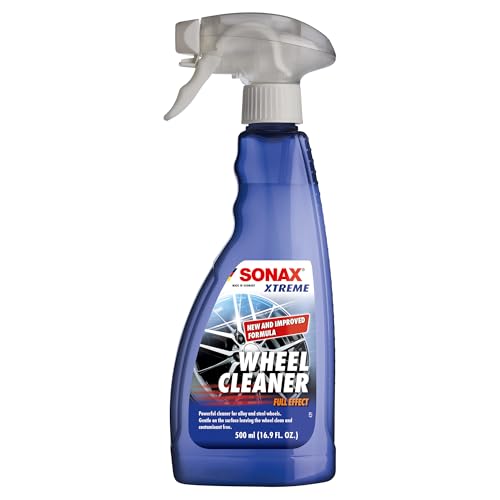
SONAX Wheel Cleaner Full Effect, Non-Acid Color-Changing Rim Cleaner, 16.9 fl oz
by SONAX
The go-to for readers who want visual proof their cleaner is pulling embedded brake dust -- SONAX bleeds red as it dissolves iron.
Pros
- Bleeds red as it works -- the color change is visual proof the formula is chemically bonding and dissolving embedded iron, not just rinsing surface dust
- Strong European detailing reputation -- SONAX is a benchmark name in the enthusiast decon world for good reason
- Non-acid despite its aggressive iron-removing action, so you get decon-level cleaning without the finish risk of an acid
- High 5,738-rating review base for a specialty formula -- broad validation that the color-changing chemistry delivers
Cons
- Smaller 16.9 oz bottle for the price versus domestic gallon options -- cost per ounce is high
- The sulfur reaction scent is polarizing -- some users find the smell during dwell unpleasant
Turtle Wax Hybrid Solutions Iron Remover — Best Budget Iron Remover
The Turtle Wax Hybrid Solutions Iron Remover (sold as Rapid Decon until Turtle Wax renamed the bottle) is the cheapest way into the color-changing iron-remover world, and it doesn’t feel like a compromise. It turns purple as it dissolves bonded fallout, giving you the same satisfying visual feedback and the same real decontamination the pricier specialty sprays deliver, at a fraction of their cost. For a buyer curious about iron removers but not ready to pay SONAX or Chemical Guys money, this is the low-risk way to try the category.
It’s also more versatile than its price suggests — it works on paint as well as wheels, so one bottle handles both a wheel decon and a paint-decontamination pass before you clay, wax, or coat. That makes it a genuinely useful addition to a wash kit rather than a single-purpose product. Being a Turtle Wax product, it’s stocked at every big-box store, so you can grab it on a normal shopping run, and the 4.5-star average across 2,219 ratings confirms it performs, not just prices, well.
It has less detailer cachet than the Chemical Guys or SONAX bottles, and it needs agitation on heavy, baked-on dust — the color change lifts the bonded iron but a brush finishes the job in the crevices. For the value-minded reader who wants the decon satisfaction and the paint-safe versatility without the specialty-brand premium, though, it’s the smart budget entry. Follow it with a clay bar treatment on the paint and you’ve got a full decontamination step for the price of one bottle.
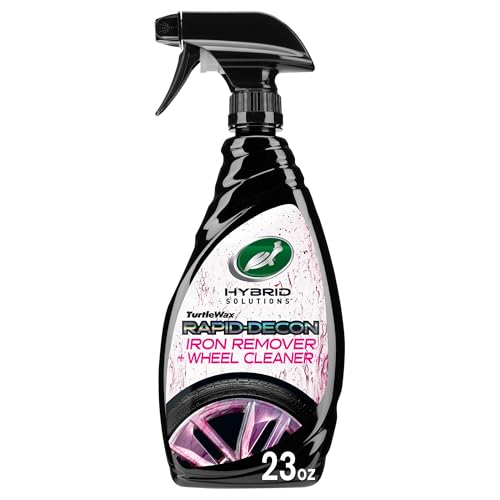
Turtle Wax Hybrid Solutions Iron Remover & Wheel Cleaner, 23 oz
by Turtle Wax
A budget-friendly color-changing brake-dust remover that keeps the satisfaction factor -- the value entry into iron decon for wheels and paint.
Pros
- The cheapest way into a color-changing iron remover -- turns purple as it dissolves fallout, so you get the decon satisfaction at a fraction of the specialty-brand price
- Works on paint as well as wheels, so one bottle handles wheel decon and a paint-decontamination pass before waxing
- Widely available at big-box stores -- easy to grab on a normal shopping run
- Solid 4.5-star average across 2,219 ratings -- a genuine value pick in the color-change segment, not a compromise
Cons
- Less detailer cachet than Chemical Guys or SONAX -- the formula is effective but not the enthusiast benchmark
- Needs agitation on heavy, baked-on dust -- the color change lifts bonded iron but a brush finishes the job
Meguiar’s Hot Rims Aluminum Wheel Cleaner — Best for Bare & Polished Aluminum
The Meguiar’s Hot Rims Aluminum is the specialist for the finish that scares people the most: bare and polished aluminum. Uncoated aluminum is soft and chemically reactive, and a harsh or acidic cleaner will cloud, pit, and permanently dull it in a single use. This formula is mild and aluminum-specific by design — it cleans the metal without etching it, which is exactly what a bare-aluminum or polished wheel needs and what a general aggressive cleaner can’t safely provide.
The delivery is a foaming gel, and that matters here. The gel clings to the wheel face for real dwell time, giving the mild formula the extended contact it needs to lift grime from soft aluminum without you having to scrub hard and risk marring the finish. Reviewers consistently call out good results on both bare aluminum and gloss-black wheels — the two finishes people are most nervous about cleaning — and it does it at an affordable price, so you’re not paying a premium for the finish-specific chemistry.
The mildness that makes it aluminum-safe means heavy grime can need a second application or a soft brush; it trades some raw aggression for the safety the finish requires, which is the correct trade. There’s also a mild chemical odor a few users note. If you’ve got bare or polished aluminum — or classic mag wheels, or a polished lip you’ve worked to keep bright — this is the dedicated cleaner that won’t ruin it. Note that it’s also listed as safe for anodized, powder-coated, and OEM clear-coat, making it more versatile than the “aluminum” name implies.
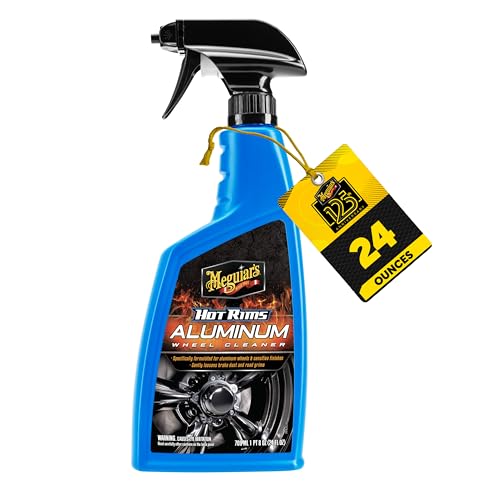
Meguiar's G14324 Hot Rims Aluminum Wheel Cleaner, 24 oz
by Meguiar's
The dedicated pick for bare or polished aluminum, where an acid cleaner would etch the finish -- a mild, aluminum-safe foaming gel.
Pros
- Purpose-built for sensitive bare and polished aluminum -- a mild, aluminum-safe formula where a general acid cleaner would etch and cloud the metal
- Foaming gel clings for real dwell time, giving the formula the contact it needs to lift grime from soft aluminum without scrubbing hard
- Reviewers consistently praise the results on bare aluminum and gloss-black finishes -- it does what it claims on the finishes that scare people
- Affordable for a specialty aluminum cleaner -- you are not paying a premium for the finish-specific formulation
Cons
- Heavy grime can need a second application or a soft brush -- the mild formula trades some aggression for aluminum safety
- Mild chemical odor that a few users note during use
Mothers Foaming Wheel & Tire Cleaner — Best for Factory-Coated Wheels
The Mothers Foaming Wheel & Tire is the trusted, no-drama gallon for the most common wheel on the road: the factory clear-coated OEM alloy. Its foaming action lifts brake dust with minimal scrubbing on wheels kept on a routine — spray it, let the foam do the work, and rinse. For the daily driver whose wheels get a regular wash, that touchless-leaning workflow is genuinely convenient, and it’s what this formula is tuned for.
Two things stand out for the maintenance buyer. First, the spot-free rinse claim — fewer water spots to chase across four wheels is a real time-saver on a full wash, especially in hard-water areas. Second, the Mothers name: this is a long-running, trusted car-care brand, so you’re buying a known quantity, and the gallon size suits frequent washers who want foaming convenience at bulk value. It’s the kind of jug that lives on the garage shelf and gets used every weekend without a second thought.
It’s explicitly marketed toward factory-coated wheels, which is both its strength and its limit — it’s less about aggressive-finish restoration than Griot’s or P&S, so neglected or heavily fouled wheels are better served elsewhere. And like every gallon here, it needs its own trigger sprayer. For OEM and factory-finish wheels on a regular maintenance routine, though, it’s a reliable, high-value foaming choice.
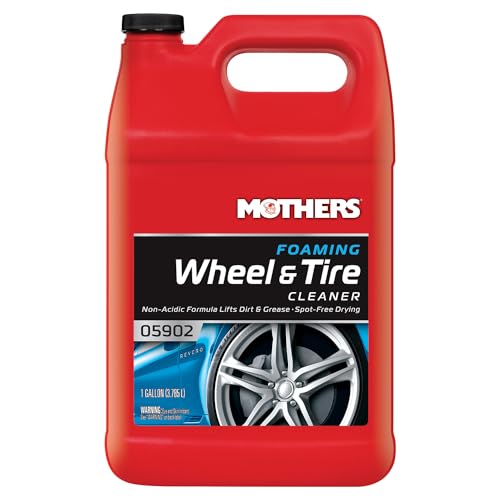
Mothers Foaming Wheel & Tire Cleaner, 1 Gallon
by Mothers
A trusted foaming gallon best suited to OEM and factory-finish wheels on a regular maintenance routine -- spray, foam, rinse.
Pros
- Foaming action lifts brake dust with minimal scrubbing -- spray, let it foam, and rinse works well on factory-coated wheels kept on a routine
- Spot-free rinse claim means fewer water spots to chase after the wash, a real time-saver on a full four-wheel job
- Mothers is a long-running, trusted car-care brand -- a safe, known-quantity choice
- Gallon size suits frequent washers who want foaming convenience at bulk-cost value
Cons
- Marketed toward factory-coated wheels -- less finish-aggression confidence than Griot's or P&S on neglected or heavily fouled wheels
- Gallon needs its own trigger sprayer, and it is best on maintenance-clean wheels rather than restoration jobs
Chemical Guys Decon Pro Iron Remover — Best for Heavy Iron Fallout
The Chemical Guys Decon Pro is the heavy-artillery pick for wheels that a plain foaming cleaner simply can’t fully decontaminate. It’s a dedicated bonded-iron fallout remover — engineered specifically to dissolve the embedded ferrous particles that heat-fuse into the finish and that general cleaners leave behind. If you’ve got a neglected set, or wheels behind aggressive semi-metallic pads that throw heavy iron, this is the formula built for exactly that problem.
Like the other iron removers here, it changes color as it works — clear to purple-red — so you can literally watch it lift the iron out of the finish and know when the reaction has run its course. It’s also safe on paint as well as all wheel types, which means it doubles as a paint-decontamination spray before you clay or apply a coating. That versatility, plus a large 3,722-rating review base, makes it a well-validated choice for the periodic deep-decon step rather than an every-wash cleaner.
Be realistic about what it is. It’s pricier per ounce than SONAX for similar color-changing iron removal, it needs dwell time and then a thorough rinse — this is a decontamination process, not a quick spray-and-go — and the sulfur smell during the reaction is strong enough that some users find it off-putting. Use it the way it’s meant to be used: as the reset tool you pull out a few times a year when general cleaning isn’t enough, not as your weekly wheel spray.

Chemical Guys Decon Pro Iron Remover & Wheel Cleaner, 16 oz
by Chemical Guys
The heavy-fallout specialist for wheels that plain foaming cleaners cannot fully decontaminate -- a dedicated bonded-iron remover that color-changes as it works.
Pros
- A dedicated bonded-iron fallout remover -- engineered specifically to dissolve the embedded ferrous particles that plain foaming cleaners leave behind on neglected wheels
- Changes color from clear to purple-red as it reacts, so you can literally watch it lift the iron out of the finish
- Safe on paint as well as all wheel types, so it doubles as a paint-decontamination spray before clay or wax
- Large 3,722-rating review base at a solid average -- broad validation of the heavy-fallout chemistry
Cons
- Pricier per ounce than SONAX for similar color-changing iron removal
- Needs dwell time and then a thorough rinse -- this is a decontamination step, not a quick spray-and-go
- Strong sulfur smell during the reaction that some users find off-putting
Best Wheel Cleaner for Brake Dust
Brake dust is the reason your wheels get dirty faster than any other part of the car, and understanding what it actually is explains why the right cleaner matters. Every time you brake, friction heats the pad and rotor and sheds tiny ferrous (iron-oxide) particles at high temperature. Those hot particles land on the wheel and, because they’re hot, they don’t just sit on the surface — they heat-fuse and chemically bond to the clear coat. That’s why a wheel can look permanently gray no matter how hard you scrub with a general cleaner: the iron is embedded, not sitting on top.
This is where color-changing iron removers earn their keep. They contain chelating agents that chemically bond to the embedded iron and dissolve it, and the purple or red color that develops is the reaction happening in front of you — proof the formula is pulling ferrous particles out of the finish. Critically, the color has nothing to do with acid strength; every remover here is non-acid. If you run semi-metallic brake pads, expect heavier fallout than a ceramic pad throws — pad compound directly drives how much iron lands on your wheels, so it’s worth knowing which you’re running (see our best brake pads guide, where ceramic vs. semi-metallic dust output is a real selection factor).
For heavy brake dust, these three iron removers are the strongest picks here: SONAX Full Effect for the enthusiast standard, the Turtle Wax Hybrid Solutions Iron Remover for the budget entry, and Chemical Guys Decon Pro for the most neglected, heavily-fouled wheels.
| Product | Price | Buy |
|---|---|---|
| SONAX Wheel Cleaner Full Effect, Non-Acid Color-Changing Rim Cleaner, 16.9 fl ozBest iron remover overall Bleeds red as it dissolves embedded iron -- the enthusiast benchmark for color-changing decon | $16.99 | View on Amazon |
| Turtle Wax Hybrid Solutions Iron Remover & Wheel Cleaner, 23 ozBest budget iron remover Turns purple and works on paint too -- the cheapest way into iron removal without compromise | $14.69 | View on Amazon |
| Chemical Guys Decon Pro Iron Remover & Wheel Cleaner, 16 ozBest for heavy fallout Dedicated bonded-iron formula for the most neglected wheels plain cleaners can't reset | $18.99 | View on Amazon |
Best Wheel and Tire Cleaner
If you’d rather not keep separate bottles for wheels and tires, an all-in-one wheel-and-tire cleaner does both jobs with one product and one pass. The chemistry is a compromise by design — a formula that cleans a painted alloy safely and also strips the old dressing and brown oxidation off a tire sidewall — but the good ones handle both well enough that most owners never need a dedicated tire cleaner. The workflow win is real: spray the whole corner of the car, agitate, and rinse, instead of switching products halfway through.
The key is picking a formula that’s genuinely versatile without being harsh. All three picks here are non-acid, so they’re finish-safe on the wheel while still cutting through the grime and old dressing on the tire. Adam’s is the enthusiast all-in-one that also does wheel wells; Armor All is the budget option you can buy anywhere; and the Mothers gallon is the high-volume foaming choice for someone doing this weekly across a factory-wheeled daily driver.
Whichever you choose, a proper wheel-and-tire clean is the correct first step in any wash — do the dirtiest part of the car first so you’re not flinging brake dust and tire grime onto paint you’ve already cleaned. Our beginner’s guide to car detailing walks through the full wash order if you want the complete routine.
| Product | Price | Buy |
|---|---|---|
| Adam's Polishes Wheel & Tire Cleaner, 16 ozBest wheel + tire all-in-one One non-acid bottle for wheels, tires, and wheel wells, with the deepest review base of the three | $11.99 | View on Amazon |
| Armor All Extreme Wheel and Tire Cleaner, 24 Fl OzBest budget wheel + tire Cheapest all-in-one worth buying, available at every big-box store for routine washes | $4.97 | View on Amazon |
| Mothers Foaming Wheel & Tire Cleaner, 1 GallonBest gallon for frequent washers Foaming gallon value for weekly washers cleaning factory-coated wheels and tires together | $30.11 | View on Amazon |
Best Aluminum and Alloy Wheel Cleaner
“Aluminum wheel” covers two very different situations, and confusing them is how finishes get ruined. The vast majority of factory alloy wheels are clear-coated — the aluminum is sealed under a protective clear layer, and any non-acid cleaner is safe on it. But bare, polished, or uncoated aluminum — classic mags, polished lips, aftermarket forged wheels finished bright — is a different animal. Raw aluminum is soft and chemically reactive, and an acidic or overly harsh cleaner will etch, cloud, and pit it permanently. Once bare aluminum is acid-etched, no cleaner brings it back; it takes polishing or refinishing.
That’s why finish identification comes first. If you’re not certain whether your wheels are clear-coated or bare, treat them as bare and use the mildest safe option. For genuinely bare or polished aluminum, Meguiar’s Hot Rims Aluminum is the dedicated pick — a mild, aluminum-specific foaming gel that cleans without etching, and it’s also rated safe for anodized, powder-coated, and OEM clear-coat finishes. For clear-coated alloys and premium aftermarket sets where you want extra cleaning power with a labeled safety guarantee, the Griot’s Garage Heavy-Duty is the pH-balanced choice. Never use an acid cleaner on any aluminum wheel unless it’s factory clear-coated and you’re following the cool-wheel, rinse-immediately rules to the letter.
| Product | Price | Buy |
|---|---|---|
| Meguiar's G14324 Hot Rims Aluminum Wheel Cleaner, 24 ozBest for bare & polished aluminum Mild aluminum-specific foaming gel that cleans soft bare aluminum without etching -- the safe choice for polished and raw finishes | $8.92 | View on Amazon |
| Griot's Garage Heavy-Duty Wheel Cleaner for All Wheel Finishes, pH Balanced, Non-Acidic, 35 ozBest for clear-coated & aftermarket alloys pH-balanced non-acid power for clear-coated and premium aftermarket alloys where you want a labeled safety guarantee | $21.99 | View on Amazon |
Best Chrome Wheel Cleaner
Chrome demands one hard rule: never use acid on it. Acid attacks the chrome plating, causes pitting and yellowing, and the damage is permanent — there’s no recovery from acid-etched chrome short of re-plating. The good news is that chrome doesn’t need anything aggressive. It’s a smooth, hard, non-porous surface, so brake dust and grime sit on top rather than embedding the way they do in a clear coat, which means a gentle non-acid cleaner lifts them off easily.
You’ll notice there’s no dedicated, high-review “chrome wheel cleaner” spray that stands out on Amazon — and that’s fine, because the correct answer is a general non-acid cleaner, not a chrome-specific product. The Chemical Guys Signature Series is the ideal pick: safe on chrome, cheap enough to use freely, and effective on the surface grime chrome collects. The Griot’s Garage Heavy-Duty is the premium alternative for chrome wheels you want to baby. For the mirror shine chrome is bought for, follow the cleaner with a dedicated chrome polish as an occasional step — something like Mothers California Gold All-Chrome is the classic choice — to remove light oxidation and restore the reflective finish. Cleaner keeps it clean; polish keeps it bright.
| Product | Price | Buy |
|---|---|---|
| Chemical Guys Signature Series Wheel Cleaner Spray for All Finishes, 16 ozBest chrome cleaner overall Non-acid and chrome-safe, cheap enough to use freely -- the correct default for chrome wheels | $10.99 | View on Amazon |
| Griot's Garage Heavy-Duty Wheel Cleaner for All Wheel Finishes, pH Balanced, Non-Acidic, 35 ozBest premium chrome cleaner pH-balanced premium formula for chrome wheels you want to baby, with the clearest safety labeling | $21.99 | View on Amazon |
Best Wheel Cleaner for Black and Powder-Coated Wheels
Gloss-black, matte-black, and powder-coated wheels are among the most popular finishes on the road right now, and they’re also among the easiest to ruin with the wrong cleaner. Powder coat and painted black finishes are surface coatings, and acid dulls, hazes, and etches them — a single use of an aggressive acidic cleaner can permanently flatten the gloss on a black wheel or leave a cloudy haze on a matte one. The rule here is strict: pH-neutral only. No acid, ever, on any coated black or powder-coated finish.
Beyond avoiding acid, the concern with black wheels is that they show everything — water spots, streaks, and residue are far more visible on gloss black than on silver, so you want a cleaner that rinses clean without leaving film. The Griot’s Garage Heavy-Duty is the top pick: explicitly pH-balanced and non-acidic, safe on all finishes, and powerful enough to clean without you needing to scrub a matte finish (aggressive brushing can itself burnish a matte coat to an uneven shine). For heavier brake dust on a black wheel, SONAX Full Effect is the pH-neutral iron remover that pulls embedded fallout without touching the coating — the color change even helps you see exactly where the dust is against the dark finish. Work in shade, keep the surface wet, and rinse thoroughly.
| Product | Price | Buy |
|---|---|---|
| Griot's Garage Heavy-Duty Wheel Cleaner for All Wheel Finishes, pH Balanced, Non-Acidic, 35 ozBest for black & powder-coat pH-balanced non-acid formula safe on gloss-black, matte, and powder-coat -- cleans without dulling the coating | $21.99 | View on Amazon |
| SONAX Wheel Cleaner Full Effect, Non-Acid Color-Changing Rim Cleaner, 16.9 fl ozBest iron remover for black wheels Non-acid color-changing iron remover that pulls embedded dust from black wheels without harming the finish | $16.99 | View on Amazon |
How to Wash Your Wheels the Right Way
Getting the most out of any wheel cleaner comes down to technique, and the biggest mistake I see is spraying cleaner on a hot, dry wheel in direct sun. Heat makes the cleaner flash-dry before it can work, and a dried cleaner streaks and can spot the finish. Always start with a cool wheel, work in shade, and pre-rinse to knock off loose grit and get the surface wet — that keeps the cleaner in its liquid working state through the full dwell.
Do the wheels and tires first, before you wash the paint. Wheels are the dirtiest part of the car, and if you save them for last you’ll fling brake dust and grime onto paint you’ve already cleaned. Spray the cleaner on, let it dwell the time the label specifies — this is where cling matters, because a foam that holds is doing chemistry while a thin spray is running down the driveway — then agitate with a dedicated wheel brush, hitting the barrel, spokes, and lug pockets that spray pressure alone never reaches. Rinse thoroughly from the top down, and use separate wash media for wheels and paint so you never drag abrasive brake dust onto your clear coat. If keeping paint swirl-free is the goal, our guide on how to wash a car without scratches covers the two-bucket method and grit guards in detail.
Finish with protection. A coat of wheel wax or a wheel-rated ceramic coating after a deep clean makes brake dust far less likely to bond, which turns every future wash into a quick spray-and-rinse instead of a scrubbing job. Protected wheels stay cleaner longer and clean up faster — it’s the single highest-return habit in wheel care.
Buyer's Guide
Choosing a wheel cleaner comes down to matching the formula to your wheel finish, how dirty your wheels get, and how often you clean them. These six factors determine which cleaner in this roundup is right for your wheels.
Acid vs. Non-Acid pH Safety
This is the single most important decision, and for almost everyone the answer is non-acid. pH-balanced, non-acidic cleaners are safe for weekly use on every wheel finish -- chrome, painted, polished, powder-coated, anodized, and ceramic-coated -- and they handle normal brake dust without any finish risk. Every primary pick in this roundup is non-acid for exactly that reason. Acid cleaners are faster and more aggressive, but they are strictly for occasional deep-cleaning of factory clear-coated steel or alloy wheels, applied cool, agitated fast, and rinsed immediately. Acid on bare aluminum, chrome, matte, or powder-coat etches and permanently hazes the finish. Unless you have a specific, neglected clear-coated wheel to restore, buy non-acid and never look back.
Wheel-Finish Compatibility
Your wheel's finish dictates what you can safely use on it. Factory clear-coated alloys -- the most common OEM wheel -- tolerate any non-acid cleaner. Bare or polished aluminum is soft and reactive, and needs a mild, aluminum-specific formula like Meguiar's Hot Rims Aluminum; a harsh cleaner will cloud and pit it. Chrome must never see acid -- a general non-acid cleaner plus an occasional chrome polish is the correct routine. Gloss-black, matte, and powder-coated wheels need strict pH-neutral chemistry because acid dulls and hazes the coating. Ceramic-coated wheels want pH-neutral only, to preserve the coating. If you run a mixed setup or you're not sure of your finish, a pH-balanced all-finish cleaner like the Chemical Guys Signature or Griot's Garage Heavy-Duty is the safe universal choice.
Iron-Removing / Color-Changing Formula Mechanism
Brake dust is not ordinary dirt -- it is iron-rich particulate thrown off hot by the pad and rotor that heat-fuses into the clear coat. General cleaners lift the surface layer; a chelating iron remover chemically bonds to the embedded ferrous particles and dissolves them, turning purple or red as proof of the reaction. The color change is a work indicator, not a measure of strength or acidity -- these products are non-acid. If your wheels are cleaned every wash, a general foamer is enough. If they've gone neglected, or you run aggressive semi-metallic pads that throw heavy iron, a color-changing remover like SONAX Full Effect, the Turtle Wax Hybrid Solutions Iron Remover, or Chemical Guys Decon Pro is worth keeping for periodic decontamination.
Foam/Gel Cling & Dwell Time
A wheel cleaner only works while it is in contact with the grime, and wheels are vertical -- so cling is what separates a cleaner that works from one that runs straight off onto the ground. Foaming and gel formulas cling to the wheel face and hold the active chemistry against the dirt for the dwell time it needs to break the bond. Thin, watery sprays sheet off quickly and give the chemistry less time to act, which usually means more scrubbing. Foaming cleaners like the Chemical Guys Signature, Mothers Foaming, and Meguiar's Hot Rims gel are the better choice for baked-on dust and hot, dry conditions. Whatever you use, work in shade on a cool wheel and pre-rinse first, so the cleaner stays wet through its dwell rather than drying on the surface.
Scrub-Required vs. No-Scrub / Touchless
"No-scrub" and "touchless" claims hold up on lightly soiled, regularly maintained wheels -- spray, dwell, and rinse genuinely works. But heavy brake dust, road grime, and the inner barrel and lug pockets still need some agitation no matter what the bottle promises. The realistic goal is to let the chemistry do the heavy lifting so a soft wheel brush or mitt only has to finish the crevices. Match the product's cling and dwell to how dirty the wheel actually is: a routinely-cleaned wheel comes clean touchless, while a neglected one always needs a brush. Keep a dedicated wheel brush on hand regardless -- spray pressure alone never fully reaches the spokes and behind the lug nuts.
Concentrate / Gallon-Refill Value Math
How much you clean determines whether a 16 oz bottle or a gallon is the smarter buy. A single-car owner who washes a few times a season is well served by a 16 to 24 oz spray -- the Chemical Guys Signature or Armor All -- with no bulk to store. But if you clean wheels weekly, run multiple cars, or you're the household detailer, a gallon like P&S Brake Buster, Meguiar's D14301, or Mothers Foaming drops the cost per wash dramatically. The catch: gallons ship without a trigger sprayer, so factor in a decanter bottle, and ready-to-use gallons take more shelf space than a concentrate you'd dilute. Do the per-ounce math against your actual usage rather than the sticker price -- the gallon almost always wins for frequent washers, and the small bottle wins for everyone else.
Final Verdict
For the overwhelming majority of drivers — any wheel finish, cleaned on a normal wash routine — the Chemical Guys Signature Series Wheel Cleaner is the correct pick. It’s non-acid and safe on chrome, painted, polished, clear-coated, and factory alloys, so you never have to worry about matching a cleaner to a finish or etching something expensive. It clings and foams the way a wheel cleaner needs to, it’s cheap enough to spray liberally, and it carries the largest verified review base in the entire category. It’s the bottle I’d put in almost anyone’s hands.
Budget-conscious buyers who just want clean wheels should grab the Armor All Extreme — it’s the cheapest cleaner here worth buying, comes in a generous size, and does the job on wheels kept on a routine. If you’ve invested in expensive aftermarket, polished, or powder-coated wheels, step up to the Griot’s Garage Heavy-Duty for its explicit pH-balanced, non-acid safety labeling and premium cleaning power. And when your wheels have gone neglected or you run aggressive brake pads that throw heavy iron, keep a color-changing iron remover like SONAX Full Effect on the shelf for periodic decontamination that a general cleaner can’t match.
Whatever you spray, remember the two rules that protect both your wheels and your wallet: non-acid is the safe default for 95 percent of finishes, and a coat of protection after a deep clean makes every wash after it faster. Clean wheels first, work cool and in shade, and let the chemistry do the work so the brush doesn’t have to.
Frequently Asked Questions
Is acid wheel cleaner safe?
What's the difference between a wheel cleaner and an iron remover?
Will wheel cleaner damage a ceramic coating or clear coat?
How often should you clean your wheels?
Do you still need to scrub with a "no-scrub" product?
Related Articles
About the Reviewer

Mike Reeves, ASE Master Technician
A.A.S. Automotive Technology, Universal Technical Institute (UTI)
Mike Reeves is an ASE Master Technician with 15 years of hands-on experience in automotive repair and diagnostics. He earned his A.A.S. in Automotive Technology from UTI and runs his own independent shop in Denver, Colorado. Mike founded RevRated to help everyday car owners make smarter parts decisions -- every recommendation comes from real-world testing in his garage.